

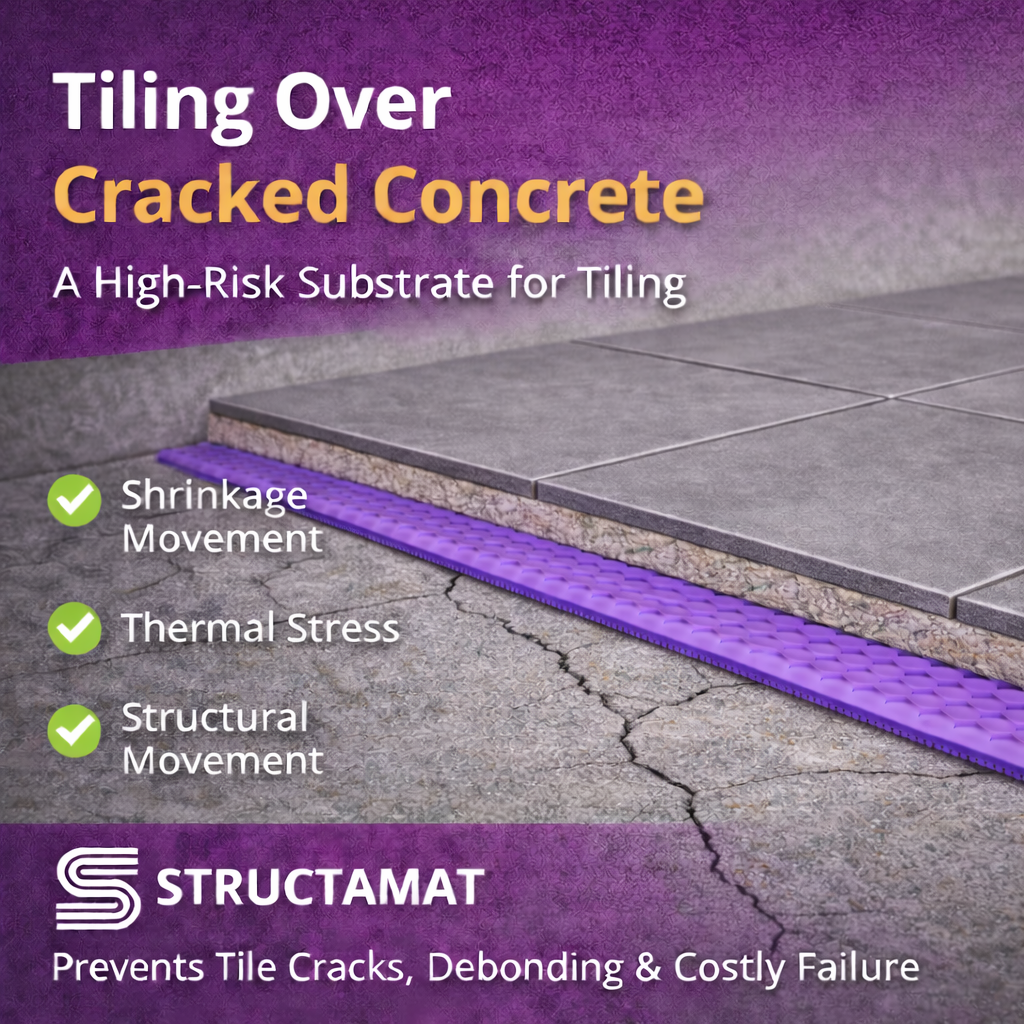
Cracked concrete is one of the most common substrates encountered in refurbishment and commercial flooring projects — and one of the most likely to cause tile failure when not correctly managed. While concrete is often assumed to be a stable base, the reality is that all concrete moves, and cracking is simply the visible symptom of that movement.
When tiles are fixed directly onto cracked concrete without a decoupling layer, the rigid tile finish is forced to respond to stresses generated within the slab. Over time, this stress almost always results in visible and costly failure.
Why is Cracked Concrete a High-Risk Substrate for Tiling?
Shrinkage During Curing
Concrete naturally shrinks as it cures and moisture evaporates. This process can continue long after the surface appears dry and ready for tiling. As the slab contracts, internal stresses are released in the form of shrinkage cracks. These cracks may appear insignificant, but they represent weak points in the substrate. Without isolation, shrinkage movement is transferred directly into the adhesive bed and tile layer, increasing the likelihood of cracked tiles or fractured grout joints.
StructaMat matting is engineered to act as a one-step underlayment system over cracked concrete, accommodating this residual movement rather than attempting to restrain it.
Thermal Expansion and Contraction
Concrete expands when heated and contracts as temperatures drop. Floors exposed to sunlight, seasonal temperature variation, or underfloor heating systems are particularly vulnerable to thermal cycling.
When tiles are bonded directly to concrete, they are effectively locked to the slab. As the concrete expands or contracts, stresses build beneath the tiles. Because tiles and grout have very limited tolerance for movement, this stress often releases through cracking, debonding, or tenting.
Many of our StructaMat mattings have a decoupling and pressure equalisation design which allow the concrete substrate to move independently of the tiled surface, dramatically reducing the transfer of thermal stress into the finished floor.
Structural and Building Movement
Even in structurally sound buildings, minor movement is unavoidable. Settlement, vibration, and deflection can all introduce lateral movement into concrete slabs over time. While this movement may be too small to detect visually, it is more than enough to damage rigid tile installations.
Cracks formed by historic settlement are especially deceptive. They may appear dormant, but they often reopen slightly as buildings respond to load changes or environmental conditions.
StructaMat mattings are specifically designed to perform on substrates prone to movement, including cracked concrete, making the range particularly well suited to renovation projects where the history of the slab is unknown.
Load Stress and Repetitive Traffic
Concrete floors in commercial and residential settings are subjected to ongoing load stress from foot traffic, furniture, rolling loads, and equipment. Over time, this stress can cause micro-movement within the slab, especially around existing cracks. Without a movement accommodation layer, these stresses concentrate beneath individual tiles, leading to hollow spots, loss of adhesion, and eventual tile failure.
StructaMat mattings feature a structured design which helps distribute point loads more evenly across the floor, reducing stress concentrations and supporting long-term performance even in high-traffic environments.
Why Adhesive Alone Is Not Enough
A common mistake when tiling over cracked concrete is relying on “flexible” adhesive alone to manage movement. While flexible adhesives can help absorb minor stress, they are not designed to isolate ongoing substrate movement.
Decoupling membranes such as our StructaMat range work differently. Rather than resisting movement, they manage and accommodate it, protecting the tile layer above. This is why StructaMat is as a preventative solution, not a remedial one, addressing movement risk before it causes visible failure
Assessing Cracked Concrete – Which Cracks Can Be Tiled Over (and Which Can’t)
Before any decoupling system is specified, cracked concrete must be properly assessed. This stage is critical. Decoupling membranes such as those in our StructaMat range are designed to manage movement, not compensate for structural failure. Understanding the type, cause, and behaviour of cracks determines whether tiling can proceed safely, and which StructaMat solution is most appropriate.
Not all cracks behave the same way. Some are the result of early-stage curing and are effectively dormant, while others indicate ongoing movement or structural stress. Tiling indiscriminately over cracked concrete, even with a decoupling membrane, can lead to premature failure if the slab is fundamentally unstable. StructaMat is engineered to perform on common problem substrates, including cracked concrete, but it must be used within the correct parameters
The following crack types are generally considered suitable for tiling over with a decoupling membrane:
Hairline Shrinkage Cracks
These are fine, surface-level cracks caused by moisture loss during the curing process. They are extremely common and often appear within the first few weeks of a slab being poured.
- Typically narrow and shallow
- Usually stable once curing is complete
- Rarely involve vertical movement
Hairline shrinkage cracks are ideal candidates for StructaMat, as the matting accommodates any residual micro-movement without allowing stress to reach the tile surface.
Stable, Non-Progressive Cracks
Cracks that have not changed in width, length, or pattern over time are generally considered stable. These are often historic cracks caused by early settlement or thermal movement.
Key indicators of stability include:
- No signs of widening
- Clean, dry edges
- No evidence of recent movement
StructaMat’s movement accommodation and pressure equalisation properties allow the tiled surface to remain isolated from these dormant cracks.
Thermal and Drying Movement Cracks
Cracks caused by expansion and contraction cycles — particularly common in floors exposed to sunlight or underfloor heating — may open and close slightly with temperature change.
These cracks:
- Often reappear seasonally
- Can be difficult to permanently “repair”
- Are best managed through isolation, not restraint
Many StructaMat mattings are compatible with heated floors and temperature-variable environments, making them well suited to managing this type of lateral movement beneath tiled finishes.
Cracks That Require Further Action Before Tiling
Some cracks indicate conditions that must be addressed before tiling, even when using decoupling matting.
Actively Moving Cracks
Cracks that continue to grow, widen, or change direction suggest ongoing movement within the slab or structure.
Warning signs include:
- Fresh or dusty crack edges
- Changes since last inspection
- Seasonal widening beyond hairline level
Decoupling membranes are not designed to compensate for continuous or uncontrolled movement. These cracks require investigation and possible structural remediation before tiling can be considered.
Cracks with Vertical Displacement
If one side of the crack is higher than the other, this indicates vertical movement or slab failure.
This is a red flag because:
- Tiles cannot tolerate vertical shear forces
- Adhesives and matting cannot bridge height differences
- Lippage and tile fracture are highly likely
In these cases, the slab must be mechanically repaired or re-levelled before any underlayment system is installed.
Structural or Load-Bearing Failure
Cracks associated with subsidence, overloading, or structural damage fall outside the scope of decoupling systems.
Examples include:
- Cracks radiating from columns or load points
- Wide cracks linked to foundation movement
- Repeated cracking after previous repairs
StructaMat is a high-performance underlayment, not a structural repair product. The substrate must first be made sound before decoupling can deliver long-term performance.
Practical On-Site Checks Before Specification
Installers and specifiers should always:
- Check cracks for movement over time where possible
- Look for signs of moisture or contamination
- Ensure no vertical displacement is present
- Confirm the surrounding concrete is firm and intact
Once stability is confirmed, StructaMat can be confidently specified as a preventative solution, protecting the tiled surface from future movement rather than reacting to failure after installation.
One of StructaMat’s strengths is its range flexibility. Depending on the project requirements, different variants can be selected:
- Standard StructaMat for general cracked concrete and timber substrates
- StructaMat XT for enhanced crack-bridging and decoupling performance
- StructaMat Pro where waterproofing and movement accommodation are both required
This allows crack management to be matched precisely to site conditions, rather than relying on a one-size-fits-all approach.
Why Decoupling Works – How StructaMat Protects Tiles Over Cracked Concrete
Once cracked concrete has been correctly assessed, the next question is how to manage the risk it presents. This is where decoupling becomes critical. Rather than attempting to restrain movement within the slab, decoupling membranes are designed to accommodate it — and this is exactly where StructaMat excels.
Decoupling is not about strengthening the slab or locking cracks in place. Instead, it introduces a controlled separation layer between the concrete substrate and the tile installation.
StructaMat functions as a one-step underlayment system that:
- Separates the tile layer from the concrete
- Allows lateral movement beneath the tiles
- Prevents stress from being transferred upward
This separation is what protects tiles from cracking, even when the substrate continues to move subtly over time.
Movement Accommodation at the Substrate Level
Cracked concrete typically moves laterally rather than vertically. StructaMat is specifically engineered to accommodate this horizontal movement, which is the most common cause of tile failure.
Its structured design allows:
- The concrete slab to expand, contract, or shift slightly
- The tile layer to remain stable and independent
- Adhesive to mechanically bond without locking movement
By absorbing movement at the substrate level, StructaMat prevents stress concentrations from forming directly beneath the tiles.
Pressure Equalisation and Load Distribution
Another key cause of tile failure over cracked concrete is uneven load distribution. Point loads from furniture, appliances, or foot traffic create high-pressure zones that concentrate stress around cracks.
StructaMat addresses this through pressure equalisation, helping to:
- Spread loads more evenly across the floor
- Reduce stress at crack lines
- Minimise shear forces within the adhesive layer
This is particularly important in high-traffic or commercial environments, where repetitive loading accelerates failure if movement is unmanaged.
Additional Performance Benefits Over Cracked Concrete
StructaMat delivers several secondary benefits that further protect tiled floors:
- Lightweight construction reduces additional load on the slab
- Waterproof options help protect cracked concrete from moisture ingress
- Compatibility with underfloor heating supports modern floor designs
- Ultra-thin profiles minimise height build-up, even in renovation settings
These features make StructaMat particularly suitable for refurbishment projects where cracked concrete, height constraints, and mixed substrates are common
Decoupling performance can be tailored to project requirements using the StructaMat range:
- StructaMat for general-purpose movement accommodation over cracked concrete
- StructaMat XT where enhanced crack-bridging and decoupling is required
- StructaMat Pro where movement accommodation must be combined with waterproofing
This range approach allows decoupling to be specified precisely, rather than over- or under-engineering the solution.
StructaMat from Quantum Group: Tile with Confidence Over Cracked Concrete
Cracked concrete is not a reason to walk away from a tiling project — but it is a reason to change the way the floor is specified. As this guide has shown, cracks are a symptom of movement, and movement must be managed, not ignored.
By correctly assessing the substrate, understanding which cracks can be safely tiled over, and introducing a decoupling layer such as StructaMat, installers can protect tiled floors from the most common causes of failure. Rather than relying on adhesives alone or hoping cracks remain dormant, StructaMat provides a controlled, engineered solution that isolates the tiled surface from ongoing substrate movement.
With options covering:
- General movement accommodation
- Enhanced crack-bridging performance
- Waterproofing and ultra-thin build-ups
The StructaMat range allows specifiers and installers to match the right system to the realities of the site — particularly in refurbishment, renovation, and high-risk concrete floors.
If you’re tiling over cracked concrete, don’t take unnecessary risks.
Specify StructaMat from the start to reduce failures, protect your installation, and deliver floors that perform long after handover.
- Speak to your Quantum Group representative today to find the right StructaMat solution for your next project.
- Stock StructaMat to give customers a proven answer to problem substrates
- Install with confidence knowing movement is managed, not transferred
Cracked concrete doesn’t have to compromise results, with StructaMat, it becomes a controlled, professional installation.