


Tile Trim Guide: How to Choose the Right Tile Trim for Edges, Corners, Bathrooms and Floors
Tile trim is used to protect exposed tile edges, create neat corners and transitions, and give tiled walls and floors a professional finished appearance. The best tile trim depends on the location, tile thickness, material, expected traffic and the look you want to achieve.
Tile trim may seem like a small finishing detail, but it can make a significant difference to the appearance and durability of a tiled installation.
Where the edge of a porcelain or ceramic tile is left exposed, it can appear unfinished and may be more vulnerable to chipping or impact. A correctly selected trim protects that edge while creating a defined line around corners, niches, wall endings, thresholds and floor transitions.
Modern tile trims are available in a wide variety of:
- Shapes
- Materials
- Colours
- Finishes
- Depths
- Applications
This means the trim can either blend discreetly into the tile or become a visible part of the design.
As part of Quantum Group, QTrim offers a premium range of tile trims, movement joints and finishing profiles for residential, commercial and professional tiling applications throughout the UK and Ireland. The current range includes aluminium, stainless steel, brass and PVC options, alongside straight-edge, round-edge, formable, transition, movement-joint and specialist profiles.
In this guide, we explain the most common types of tile trim, how to choose the correct size and finish, where different profiles are used, and how QTrim can be paired with Navarro Tiles to create a coordinated complete-tile solution.
What Is Tile Trim?
Tile trim is a profile installed along an exposed tile edge, corner, junction or transition to protect the tile and provide a neat finished appearance.
Tiles are usually installed so that the main face is visible while the unfinished edge is concealed.
However, there are many areas where this is not possible, including:
- External wall corners
- Shower enclosures
- Half-height tiled walls
- Window reveals
- Recessed niches
- Kitchen splashbacks
- Steps
- Floor transitions
- Tile borders
- Changes between different materials
In these situations, a trim provides a deliberate finishing detail.
Depending on the profile, it may also provide additional functions such as:
- Protecting tile edges from impact
- Creating curved or square corners
- Bridging different floor heights
- Dividing tile finishes
- Accommodating movement
- Finishing tile-to-vinyl junctions
- Improving grip at stair edges
Why Do You Need Tile Trim?
Tile trim protects vulnerable tile edges and creates a clean, finished junction where tiles would otherwise remain exposed.
Porcelain and ceramic tiles are durable when installed correctly, but exposed edges can be more susceptible to damage than the main tiled surface.
This is especially important in areas exposed to:
- Foot traffic
- Trolleys
- Cleaning equipment
- Impact
- Repeated use
- Moisture
- Commercial traffic
A good trim therefore provides both a decorative and practical function.
It can also transform the overall look of the installation.
For example, a black tile trim can create a strong architectural frame around a pale tiled wall, while a brass or bronze trim can coordinate with bathroom brassware.
What Are the Common Types of Tile Trim Available?
There are several types of tile trim, and each is designed for a different application.
The current QTrim range includes profiles for tile edges, corners, transitions, movement accommodation, stairs, flooring junctions and decorative detailing.
Straight Edge Tile Trim
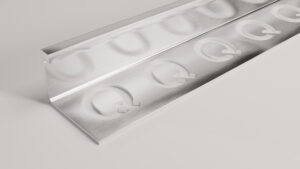 Straight edge tile trim is one of the most commonly used profiles and is designed to finish and protect exposed tile edges.
It is typically used around:
- External wall corners
- Window reveals
- Shower enclosures
- Niches
- Half-height tiled walls
- Splashbacks
- Tiled feature areas
The profile usually has an anchoring leg that sits beneath the tile, with the visible section covering the tile edge.
Straight-edge trims are particularly popular because they create a crisp, contemporary finish.
QTrim offers straight-edge profiles in a variety of materials and finishes, including aluminium, stainless steel, brass and PVC.
Round Edge Tile Trim
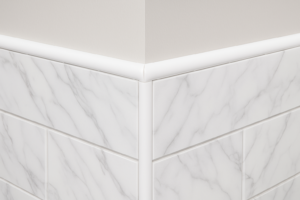 Round edge tile trim creates a softer curved finish around exposed tile corners and edges.
It can be a useful alternative to square straight-edge trims where a more traditional or rounded detail is preferred.
Round profiles are commonly used around:
- External wall corners
- Shower edges
- Bathroom walls
- Kitchen tiling
- Decorative tiled features
QTrim currently offers both open and closed round profiles.
What Is Bullnose Tile Trim?
Traditionally, bullnose tiles were manufactured with one rounded finished edge and were widely used to finish corners and tiled wall endings.
Today, many installations use a separate metal or PVC trim instead.
Modern tile trims provide greater flexibility because the same tile can be used across the entire surface while the trim creates the finished edge.
They also allow designers to coordinate the trim with other features such as:
- Taps
- Shower frames
- Handles
- Lighting
- Door hardware
- Other metal finishes
External Corner Tile Trim
External corner tile trim protects the exposed corner where two tiled surfaces meet.
Corners are particularly vulnerable to impact because they project beyond the surrounding surface.
This makes edge protection important in:
- Bathrooms
- Commercial washrooms
- Kitchens
- Hotels
- Retail interiors
- Schools
- Public buildings
A straight-edge, round-edge or box-style trim can be selected depending on the desired appearance.
Internal Corner Tile Trim
Internal corner tile trim provides a neat finish where two tiled surfaces meet inside a corner.
It may be used in:
- Showers
- Bathrooms
- Kitchens
- Wall-to-wall junctions
- Worktop junctions
- Commercial wash areas
The correct internal detail depends on the tile system and the movement or waterproofing requirements of the installation.
Decorative trim should not be used as a substitute for appropriate waterproofing or movement accommodation where these are required.
Formable Tile Trim
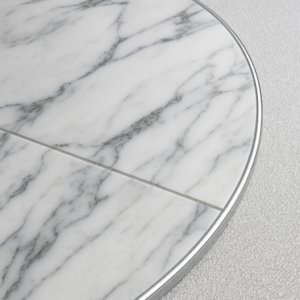 Formable tile trim is designed to follow curved or irregular tile edges.
Standard rigid trims are suited to straight runs, but curved walls, circular features and shaped floor details require a profile capable of being formed.
Formable trims can be used around:
- Curved walls
- Circular platforms
- Feature floors
- Columns
- Custom shower areas
- Architectural details
The QTrim range currently includes a formable straight-edge trim designed specifically for curved tile applications.
Box and Qbec Tile Trim
Box-style trims create a more pronounced square edge than a conventional straight profile.
They are often used where the trim is intended to become a visible design feature.
QTrim’s Qbec Box profile provides a right-angled edge and can be used to finish tiled edges or create decorative tile borders.
This style can work particularly well in contemporary bathrooms where strong, clean lines are part of the overall design.
Listello and Decorative Tile Trim
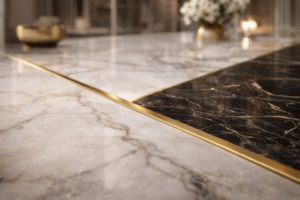 Listello trims are decorative strips used within a tiled surface rather than simply around its outside edge.
They may be used to:
- Separate different tile colours
- Create horizontal borders
- Divide decorative areas
- Introduce metallic detailing
- Break up large tiled walls
This can be especially effective where two Navarro tile finishes are being combined within one installation.
For example, a decorative metallic trim could divide a plain large-format tile from a feature tile or patterned area.
Flat Bar Tile Profiles
Flat bar profiles are thin decorative strips that can be used within tile, stone and other hard surfaces.
They can create a subtle metallic line between:
- Marble-effect tiles
- Terrazzo
- Natural stone
- Porcelain
- Different tile colours
Rather than simply finishing an edge, the profile becomes part of the surface design.
Movement Joint Profiles
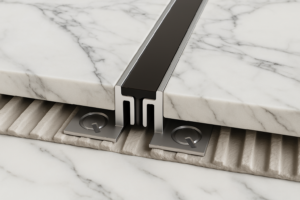 Movement-joint profiles are designed to accommodate movement within tiled floors and walls.
They perform a very different role from ordinary decorative tile trim.
Movement can occur because of:
- Thermal expansion
- Underfloor heating
- Structural movement
- Changes in moisture
- Large tiled areas
- Changes in substrate
Movement joints divide tiled surfaces into controlled sections and help reduce stress within the installation.
QTrim offers both metal and PVC movement-joint profiles for tiled wall and floor applications.
Tile to Floor Transition Trim
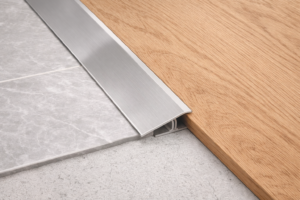 Transition profiles are used where two floor coverings meet.
This may include:
- Tile to carpet
- Tile to laminate
- Tile to wood
- Tile to vinyl
- Tile to another hard floor
Where the surfaces are at different heights, a ramped transition can provide a smoother change in level.
The QTrim Transition Profile is specifically designed to create a join between floor coverings at different heights.
We have covered this topic in more detail in our dedicated guide to tile to floor trim and transition profiles, which would be a very useful internal link from this section.
Tile to Vinyl and Skirting Trim
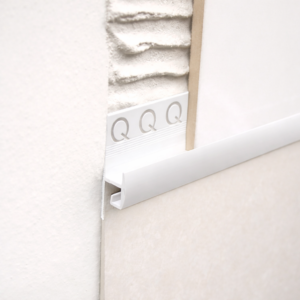 A specialist profile is often required where resilient vinyl flooring is coved upwards to meet wall tiles.
This type of profile is commonly known as:
- H trim
- Tile-to-vinyl capping
- PVC skirting trim
It is particularly common in:
- Commercial kitchens
- Healthcare environments
- Changing rooms
- Schools
- Leisure facilities
- Commercial washrooms
QTrim currently offers PVC Skirting Trim alongside other specialist finishing profiles.
Stair Nosing and Protective Tile Edging
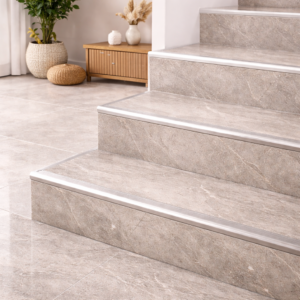 Tile trims are also important at stair edges.
A stair profile can:
- Protect the exposed tile edge
- Make the step edge easier to identify
- Provide a more professional finish
- Add grip depending on the profile design
QTrim offers both stair nosing and stair-edge options, including heavy-duty profiles for more demanding installations.
How Do You Choose the Correct Tile Trim?
The right trim depends on several factors.
1. Where Is the Trim Being Installed?
Start by identifying the application.
Ask whether the trim is required for:
- A wall edge
- External corner
- Internal corner
- Shower
- Niche
- Window reveal
- Floor transition
- Movement joint
- Stair
- Decorative border
Different locations require different profiles.
2. What Thickness Is the Tile?
Tile trim is available in different internal depths.
The trim should be selected to suit the actual tile thickness and installation detail.
A profile that is too small may fail to protect the tile edge properly.
One that is too large may leave an unattractive lip or gap.
Check the actual tile before ordering rather than relying only on a nominal tile description.
Should Tile Trim Be Flush With the Tile?
Tile trim should generally sit neatly in relation to the finished tile surface rather than projecting significantly above it.
The goal is to protect the edge while maintaining a clean finish.
Correct profile depth is therefore essential.
The installer should also account for the fixing bed and product-specific installation instructions.
3. What Material Should You Choose?
Modern tile trims are available in several materials.
Aluminium Tile Trim
Aluminium is popular because it offers a balance of:
- Durability
- Low weight
- Design flexibility
- Cost-effectiveness
- Wide finish choice
It is suitable for many residential and commercial applications.
Stainless Steel Tile Trim
Stainless steel offers increased strength and durability and may be appropriate for demanding applications.
It is particularly useful where a robust metal finish is required.
Brass Tile Trim
Brass can provide both durability and a distinctive premium appearance.
It pairs particularly well with:
- Brass taps
- Warm marble-effect porcelain
- Beige tiles
- Natural stone designs
- Luxury bathroom interiors
PVC Tile Trim
PVC provides an economical and practical finishing option.
It is commonly used where:
- Cost is important
- A simple coloured finish is required
- Lightweight profiles are suitable
- Specialist skirting or movement-joint profiles are being used
QTrim’s current range includes aluminium, stainless steel, brass and durable PVC trims.
How Do You Choose a Tile Trim Colour?
Tile trim can either:
Match the tile or contrast with it.
Matching creates a quieter, more seamless appearance.
Contrasting makes the trim a visible part of the design.
The current QTrim range includes finishes such as:
- White
- Jasmine
- Grey
- Black
- Light Grey
- Limestone
- Sandstone
- Granite
- Basalt
- Brass
- Copper
- Bronze
- Chrome
with effects including:
- Mill
- Satin
- Polished
- Brushed
- Matt
according to Quantum’s current 2026–27 product guide.
Black Tile Trim
Black tile trim is particularly effective in contemporary bathrooms.
It can coordinate with:
- Black taps
- Black shower frames
- Black-framed mirrors
- Dark lighting fixtures
- Black accessories
Against white or pale stone-effect tiles, it creates a strong architectural outline.
Brass Tile Trim
Brass works especially well with warm, luxurious schemes.
Consider pairing it with:
- Cream porcelain
- Beige stone-effect tiles
- Warm marble-effect porcelain
- Dark green feature tiles
- Natural timber furniture
The trim can then coordinate with brassware throughout the room.
Chrome Tile Trim
Chrome remains a useful choice for bathrooms with polished fittings.
It works particularly well with:
- White porcelain
- Marble-effect tiles
- Cool grey tiles
- Chrome taps and shower fittings
Stone-Finish Tile Trim
Stone-inspired finishes allow the trim to blend more closely with natural-looking porcelain.
QTrim currently includes finishes such as:
- Limestone
- Sandstone
- Granite
- Basalt
These are particularly useful for modern bathrooms where a strong metallic edge would interrupt the overall design.
How to Pair QTrim with Navarro Tiles
One of the advantages of Quantum supplying both QTrim and Navarro Tiles is the ability to think about the tile and finishing details together rather than treating trim as an afterthought.
Navarro is Quantum Group’s wholesale porcelain and ceramic tile range, supplied on a trade-only basis throughout the UK and Ireland.
The most effective pairings depend on the tile style.
Stone-Effect Navarro Tiles
Stone-look porcelain usually works best with understated trims.
Consider:
- QTrim Limestone
- QTrim Sandstone
- QTrim Basalt
- QTrim Grey
These allow the trim to coordinate with the natural tones of the tile without introducing unnecessary contrast.
Marble-Effect Navarro Tiles
Marble-effect porcelain gives more opportunity to use trims as a luxury design detail.
Possible combinations include:
- Brass with warm-veined marble
- Chrome with cool white marble
- Bronze with warmer stone tones
- Black with bold white marble
The right combination depends on the brassware and other room finishes.
Concrete-Effect Navarro Tiles
Concrete-look porcelain suits simple architectural finishes.
Good combinations include:
- Grey
- Light Grey
- Basalt
- Black
- Satin aluminium
A subtle trim can preserve the minimalist look, while black can create a stronger industrial-style edge.
Terrazzo and Decorative Tiles
Because terrazzo and patterned tiles already contain multiple colours, the trim should normally coordinate with either:
- The dominant tile colour
- The grout
- The room’s metal finishes
A simple black, grey, brass or chrome trim can help frame the pattern without competing with it.
Should Tile Trim Match the Taps?
It does not have to, but coordinating finishes can produce a much more considered result.
For example:
- Brass trim + brass taps
- Black trim + black shower frame
- Chrome trim + chrome fittings
- Bronze trim + warm metallic accessories
Alternatively, the trim can be matched to the tile itself rather than the brassware.
The key is to make the choice intentional.
Best Tile Trim for Bathroom Walls
The best tile trim for a bathroom wall depends on the tile thickness, corner or edge being finished, moisture exposure and desired appearance.
Straight-edge trims are one of the most versatile options for:
- Shower edges
- Half-height walls
- Niches
- Window reveals
- External corners
Round or box profiles may be chosen where a softer or more decorative shape is preferred.
For wet areas, the trim should form part of a properly specified tiling system rather than being relied upon as waterproofing.
How to Select the Correct Tile Trim for a Shower Enclosure
For a shower enclosure, consider:
- Tile thickness
- Position of exposed edges
- Corner shape
- Trim material
- Colour and finish
- Waterproofing detail
- Movement requirements
The profile should protect the tile edge and sit neatly with the finished surface.
A tile trim does not replace a suitable waterproofing or tanking system behind the tiles.
How to Install Tile Trim
The exact method will depend on the QTrim product being used, but most mechanically anchored tile edge trims are installed during tiling.
Step 1: Measure the Area
Measure each edge requiring trim.
Allow for:
- Corners
- Mitres
- Junctions
- Waste from cutting
Planning the trim layout before fixing the tiles usually produces a cleaner result.
Step 2: Select the Correct Trim Depth
Check the actual tile thickness and select the appropriate profile.
Dry-fit the trim against the tile before installation.
Step 3: Cut the Trim
Measure carefully and cut the profile with a suitable tool for the material.
Where two trims meet at a corner, they may require:
- Square joints
- Mitred joints
- Compatible corner pieces, depending on the system
Edges should be clean and free from burrs.
Step 4: Apply Tile Adhesive
Spread the specified tile adhesive over the prepared substrate.
The anchoring leg of the trim should be fully bedded into the adhesive.
Step 5: Position the Trim
Press the trim into place and ensure it is:
- Straight
- Level
- Correctly aligned
- At the appropriate finished height
Additional adhesive should pass through and around the perforated anchoring leg where the product design requires it.
Step 6: Install the Tiles
Bed the adjoining tile into the adhesive and position it neatly beside the trim.
Maintain the joint specified for the installation.
Step 7: Grout and Finish
Once the adhesive has cured according to the manufacturer’s instructions, grout the surrounding tiled area as specified.
Clean the visible trim surface promptly and carefully.
Always follow the installation instructions supplied with the specific QTrim profile and the wider tile-fixing system.
Common Tile Trim Mistakes to Avoid
Even a high-quality tile installation can look poor if the trim is badly selected or installed.
Common mistakes include:
- Choosing the wrong trim depth
- Leaving tile edges exposed
- Mixing too many metallic finishes
- Selecting the trim after tiling has started
- Poorly cut mitred corners
- Scratching decorative finishes during installation
- Using an unsuitable profile for a high-traffic area
- Using standard edge trim where a movement or transition profile is actually required
- Treating decorative trim as waterproofing
- Failing to coordinate trim with the tile design
The easiest way to avoid many of these issues is to choose the tile and trim together.
Frequently Asked Questions About Tile Trim
What is tile trim used for?
Tile trim protects and finishes exposed tile edges, corners and junctions. Some profiles also create transitions, accommodate movement or provide specialist flooring details.
Do you need tile trim?
Not every tile edge requires a separate trim, but exposed unfinished edges generally need an appropriate finishing solution such as a profile, suitable finished tile edge or other specified detail.
What size tile trim do I need?
Select the profile according to the actual tile thickness and the installation detail. Always check the individual product dimensions before ordering.
What is the best tile trim for corners?
Straight-edge, round-edge and box trims can all be used for external corners. The best option depends on the desired shape, tile thickness and installation environment.
Is metal tile trim better than PVC?
Neither is universally better. Metal trims generally provide increased strength and a premium decorative finish, while PVC can offer an economical and practical solution for appropriate applications.
What tile trim works with marble-effect tiles?
Chrome, brass, bronze, black and stone-inspired finishes can all work well. The best option depends on the colour of the tile veining and the other finishes within the room.
Can tile trim be used on floors?
Yes, but the profile must be suitable for floor use. Depending on the application, this may require an edge profile, transition trim, movement joint or stair profile rather than a standard wall trim.
Can you use tile trim around a window?
Yes. Tile trim is commonly used around tiled window reveals to protect exposed edges and create a neat frame.
Complete Your Tile Installation with QTrim and Navarro
The right tile trim does far more than hide an unfinished edge.
It can protect vulnerable corners, improve durability, create smooth transitions and become a deliberate part of the overall interior design.
The QTrim range includes premium tile trims and movement profiles manufactured from materials including aluminium, stainless steel, brass and PVC, with solutions for walls, floors, corners, transitions, stairs and specialist junctions.
When paired with Navarro Tiles, retailers, designers and installers can consider the tile and finishing profile together — whether creating a subtle stone-effect bathroom, a contemporary concrete scheme, a luxury marble-look interior or a statement feature wall.
Both QTrim and Navarro form part of Quantum Group’s wholesale tiling offer across the UK and Ireland.
To explore the QTrim range, find your nearest stockist or enquire about stocking QTrim and Navarro Tiles, contact the Quantum Group team today.