

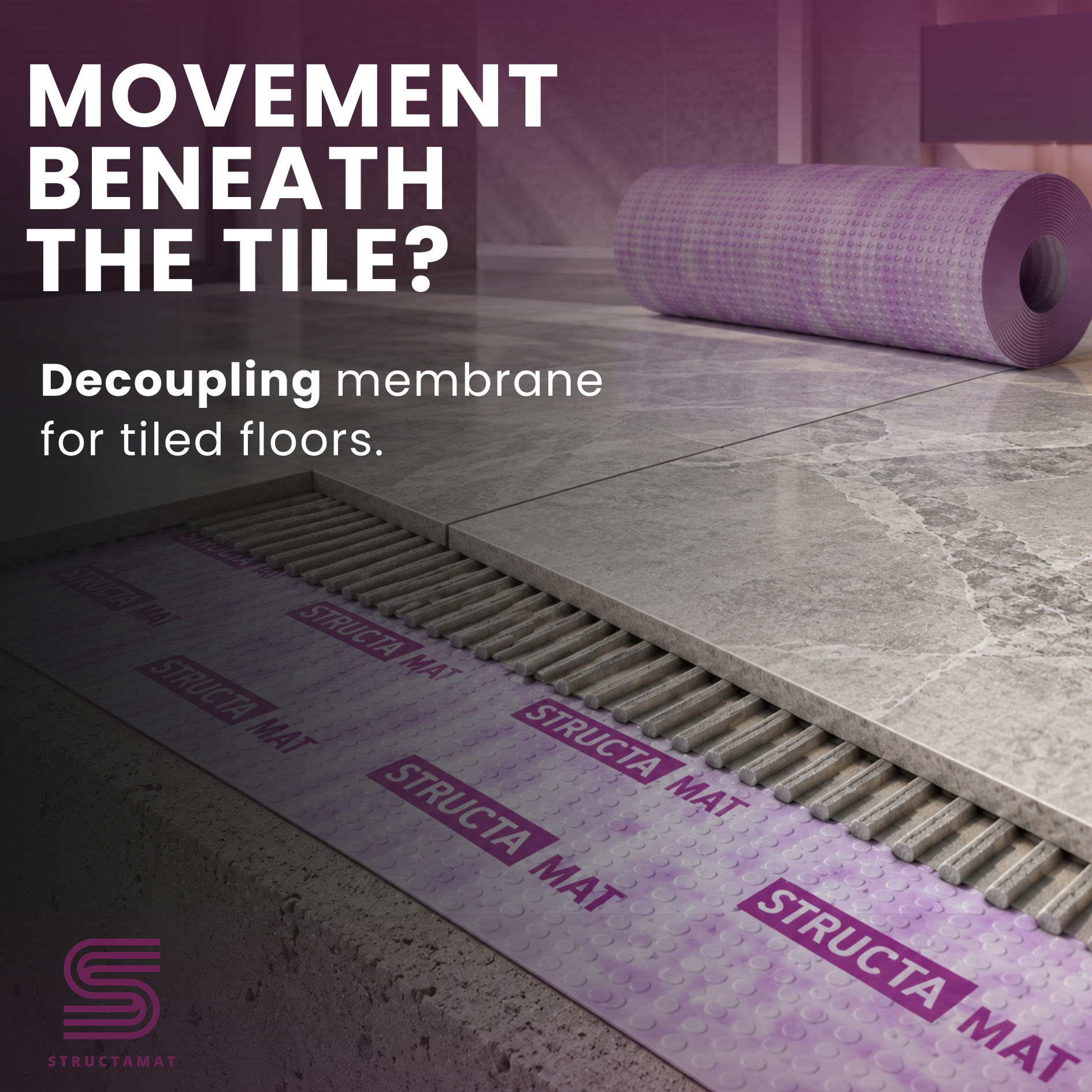
A tiled floor may look solid and permanent, but the surface underneath it is rarely completely static.
Concrete can shrink or develop minor cracks. Timber can expand and contract. Underfloor heating repeatedly warms and cools the floor structure. Renovation projects can introduce a mixture of old and new substrates, each behaving differently.
When movement beneath the floor is transferred directly into a rigid tiled surface, the result can be cracked grout, cracked tiles, loss of adhesion or, in more serious cases, sections of the floor requiring replacement.
Movement protection helps reduce the transfer of these stresses between the substrate and the finished tiled surface.
This is where products such as StructaMat movement matting become an important part of the complete tiling system.
For professional tilers, it provides an additional way to manage challenging substrates. For tile retailers and merchants, it creates an opportunity to supply customers with more than simply tiles and adhesive — helping them select the products required for a complete, considered installation.
Why Does Movement Occur Beneath Tiled Floors?
Tiles, grout and adhesive form a comparatively rigid surface. The building materials beneath them, however, can respond to changes in moisture, temperature and load.
The important point is that the substrate and tiled surface do not necessarily move together.
Even relatively small movements can generate stress within a tiled installation.
Common causes include:
Drying and Shrinkage
Concrete and screeded floors contain moisture when installed. As they dry, some shrinkage can occur.
Where movement within the substrate is transferred directly through the adhesive bed, stress can develop in the tiled surface above.
Changes in Temperature
Building materials expand when heated and contract as they cool.
This can be particularly important in floors incorporating underfloor heating, where heating and cooling cycles occur repeatedly throughout the lifetime of the installation.
Timber Movement
Timber naturally responds to changes in temperature and moisture.
A suitably prepared timber floor may still experience small amounts of seasonal movement, making movement management especially important when a rigid tile covering is installed above it.
Existing Cracks
Older concrete and screeded floors may already contain cracks resulting from previous shrinkage or movement.
Where tiles are bonded directly over these areas, continued minor movement can potentially transfer through to the tiled finish.
Renovation and Mixed Substrates
Refurbishment projects often involve more complicated floors than new-build installations.
An installer might encounter different substrates within the same room, historic repairs, extensions, previously removed floor coverings or areas that have behaved differently over many years.
This makes understanding what lies beneath the tiles particularly important.
What Is Movement Matting?
Movement matting, also commonly called an uncoupling or decoupling membrane, is installed between a suitable substrate and the tiled surface to help reduce the transfer of movement and stress into the tiles above.
Instead of bonding the tile covering directly to the floor structure, the matting introduces an intermediate layer within the installation.
This helps accommodate minor movement within the substrate before that movement reaches the rigid tile finish.
StructaMat has been developed as a movement matting solution for tiled floors and can form part of a complete installation system where movement protection is required.
It is particularly relevant for applications involving:
- Underfloor heating
- Renovation work
- Timber substrates
- Concrete and screeded floors
- Existing minor substrate cracking
- Challenging floor constructions
- Projects where additional movement protection is desirable
Correct substrate preparation, adhesive selection and movement joints remain essential. Movement matting should be used as part of the overall installation system rather than as a substitute for good tiling practice.
Why Use StructaMat with Underfloor Heating?
Underfloor heating creates repeated thermal movement as the floor heats and cools, making movement management an important consideration in tiled installations.
When an underfloor heating system is switched on, materials within the floor assembly warm and expand slightly. When the system cools, those materials contract again.
This process is repeated throughout the life of the floor.
Tiles themselves are extremely durable, but they are also rigid. Managing the stresses created beneath them can therefore help reduce the risk of movement-related problems.
A suitable StructaMat solution can be incorporated into the floor construction to provide a movement accommodation layer between the heated substrate and tile finish.
It should form part of a correctly designed installation that also considers:
- Suitable adhesives and grouts
- Required movement joints
- Appropriate substrate preparation
- Correct commissioning of the underfloor heating system
- Tile format and adhesive coverage
For retailers, asking whether a customer has underfloor heating is therefore an important part of recommending the complete installation system.
Why Is Movement Matting Useful in Renovation Projects?
Renovation floors often contain more unknowns than new substrates, making movement protection particularly valuable.
When a floor covering is removed from an older property, installers may discover:
- Historic cracks
- Previous repairs
- Different substrate materials
- Old screeds
- Timber sections
- Extensions meeting the original building
- Areas of localised movement
The finished tiled floor may cover all of these areas, even though the materials underneath behave differently.
Preparing and stabilising the substrate remains the first priority. However, once the floor has been confirmed as suitable for tiling, movement matting can provide another layer of protection between those existing conditions and the new tile installation.
This is particularly relevant when customers are investing in porcelain or large-format floor tiles and want to protect that investment over the long term.
Can StructaMat Be Used Over a Challenging Substrate?
StructaMat can be particularly useful where the substrate has a greater potential for movement, but the underlying floor must first be suitable for tiling.
Movement matting should not be used to hide a structural problem.
Before installation, the floor should be assessed for:
- Stability
- Excessive movement or deflection
- Significant cracking
- Loose or damaged areas
- Moisture problems
- Contamination
- Flatness
Any underlying problems that would make the floor unsuitable for tiling need to be corrected first.
Once the substrate has been appropriately prepared, movement matting can help manage smaller stresses that occur during the normal life of the floor.
Does StructaMat Level an Uneven Floor?
No. StructaMat is movement matting, not a floor-levelling compound.
This is an important distinction for both installers and retailers.
If a substrate contains significant:
- Dips
- High spots
- Hollows
- Ridges
- Uneven transitions
these should be corrected using an appropriate preparation method before the movement matting is installed.
StructaMat follows the prepared substrate beneath it; its role is to help manage movement rather than create a level surface.
A well-designed installation may therefore involve several stages:
substrate preparation → levelling where required → movement protection → adhesive → tiles.
Thinking about the floor as a complete system helps avoid expecting one product to perform a job it was not designed to do.
Can Movement Matting Prevent Tiles from Cracking?
Movement matting can help reduce the risk of movement-related cracking, but no membrane can guarantee that a tiled floor will never crack.
The final performance of the floor depends on the complete installation.
Important factors include:
- Structural stability
- Substrate preparation
- Correct movement joints
- Suitable adhesive
- Adequate adhesive coverage
- Tile format
- Installation technique
- Underfloor heating design and commissioning
Where serious structural movement or significant vertical displacement exists, the underlying problem must be investigated rather than simply covered with a membrane.
StructaMat should therefore be considered an important risk-management component within the tiling system, rather than a cure for every possible substrate problem.
Why Movement Protection Is Particularly Important with Large-Format Tiles
The popularity of large-format porcelain has changed the demands placed on tiled floors.
Large tiles create attractive, uninterrupted surfaces with fewer grout joints, but they also create larger areas of rigid material.
As tile size increases, achieving the correct substrate flatness, adhesive coverage and movement management becomes increasingly important.
A typical installation involving large-format flooring may therefore require consideration of:
- Floor preparation
- Levelling
- Priming
- Movement matting
- Flexible adhesive
- Levelling systems
- Suitable grout
- Movement joints
This is another reason why selling individual tiling products in isolation can overlook important parts of the overall installation.
Selling a Complete Tiling System
For tile retailers and builders’ merchants, StructaMat represents more than an additional product to put on the shelf.
It creates an opportunity to move from selling individual products to helping customers build the complete installation system.
A customer buying floor tiles may also require:
- Substrate preparation products
- Primers
- Levelling compounds
- Movement matting
- Waterproofing products
- Tile adhesive
- Levelling clips and wedges
- Grout
- Tile trims
- Sealants
- Installation tools
Asking a few questions at the point of sale can help identify these requirements.
For example:
What are you tiling onto?
Is there underfloor heating?
Is it a renovation or new floor?
Are there existing cracks?
Is the area wet or dry?
What size tiles are being installed?
These questions help retailers provide better technical support while identifying products the customer may otherwise have overlooked.
Instead of simply supplying a box of tiles and adhesive, the merchant can help the installer or homeowner consider the entire floor build-up.
Movement Protection Can Help Protect the Whole Installation
Tiles are often one of the most visible — and valuable — elements of a flooring project.
But their long-term performance depends heavily on what happens underneath them.
Spending time preparing the substrate and selecting the appropriate installation products can help reduce the risk of much more expensive remedial work later.
Where movement is a concern, incorporating StructaMat into the system provides an additional layer designed to help manage the relationship between the substrate and tiled finish.
This can be particularly valuable on:
- Heated floors
- Renovation projects
- Timber substrates
- Cracked or ageing concrete
- Large-format tile installations
- Floors where movement protection is an important consideration
Which StructaMat Product Do You Need?
Different projects require different solutions, so the correct product should always be selected according to the substrate and installation requirements.
The StructaMat range includes options for general movement accommodation as well as specialist applications where requirements such as waterproofing, low build-up or acoustic performance also need to be considered.
If you’re unsure which product is appropriate, speak to the Quantum team before specifying the system.
Ask Quantum About StructaMat
Movement beneath a tiled floor can become an expensive problem above it.
Considering substrate movement before the tiles are installed can help create a more reliable and professionally specified floor system.
For tile retailers and merchants, StructaMat also provides an opportunity to offer customers a more complete installation solution, combining the tile itself with the products required beneath and around it.
Ask your Quantum account manager about StructaMat availability, supporting products and point-of-sale material.
Alternatively, contact Quantum Group for more information about the StructaMat range or to find your nearest stockist.