

Which tile cutting tool should you use?
Use a cutting wheel and manual tile cutter for fast straight cuts, a diamond blade or cutting disc for harder materials and powered cutting, a diamond hole saw or hole cutter for pipework and fittings, and a tile drill bit for smaller fixing holes. The best choice depends on the tile material, cut shape, thickness and finish required.
Choosing the right tile cutting tool can make the difference between a clean professional finish and chipped edges, cracked tiles or unnecessary waste. Ceramic, porcelain, natural stone and glass all behave differently, so there is no single cutter, blade or drill bit that is ideal for every job.
At Quantum Group, we supply tile cutting products to retailers, wholesalers, builders’ merchants and online retailers across the UK and Ireland, including the Tylix range of diamond blades, diamond hole cutters, drill bits and tile nippers, alongside electric wet saws and specialist cutting accessories. Quantum Group NI
What is the difference between a tile cutter blade, cutting wheel and hole saw?
Although the terms are sometimes used interchangeably, these tools perform very different jobs.
| Tool | What it does | Best suited to |
|---|---|---|
| Manual cutter / cutting wheel | Scores the tile so it can be snapped along a straight line | Ceramic and suitable porcelain tiles |
| Diamond tile cutter blade/disc | Cuts through the tile using a powered tool | Porcelain, ceramic, granite, marble and other hard materials |
| Wet saw blade | Diamond blade used with water cooling | Controlled straight cuts in dense porcelain and stone |
| Diamond hole saw / hole cutter | Creates larger circular openings | Pipes, valves, wastes and fittings |
| Diamond drill bit | Drills smaller-diameter holes | Fixings, screws and smaller penetrations |
| Tile nippers | Remove small sections of material | Curves, mosaics and detailed shaping |
The most important thing is to choose the tool according to the cut you need to make, rather than simply the tile itself.
When should you use a manual tile cutter and cutting wheel?
A manual tile cutter uses a small cutting or scoring wheel to score the glazed face of the tile. Pressure is then applied so the tile breaks cleanly along the score line.
For straightforward repetitive cuts, this is often one of the quickest methods because there is no water, electricity or significant dust involved.
A cutting wheel is particularly useful for:
- straight cuts across ceramic tiles;
- suitable porcelain tiles where the cutter is designed for them;
- repetitive cuts across a room or project;
- situations where portability and speed are important.
It isn’t the right solution for every cut. A scoring wheel cannot create a circular pipe opening, and very detailed shapes normally require another tool.
Quantum’s current product range also includes Montolit spare cutting wheels for compatible manual cutters. Quantum Group NI
Is a cutting wheel the same as a tile cutter blade?
No. A manual tile cutter scores rather than saws through the tile. Its wheel creates a controlled line in the surface before the tile is snapped.
A diamond blade or cutting disc is fitted to powered cutting equipment and actually removes material as it passes through the tile.
That distinction is particularly important when moving from standard ceramic tiles to dense porcelain, natural stone or more complicated cuts.
When should you use a diamond tile cutter blade?
A diamond blade is normally the better option when you need powered cutting through hard tile materials.
The correct blade will depend on:
- whether you are cutting ceramic, porcelain or natural stone;
- whether the cut will be made wet or dry;
- the diameter and bore required by the machine;
- maximum permitted RPM;
- whether the cut edge will remain visible;
- tile thickness and density.
For exposed edges, cut quality becomes especially important. A thin, controlled blade can help achieve a cleaner edge than a blade chosen primarily for fast material removal.
Tylix TTE115 Ultrathin Pro Blade
The Tylix TTE115 is a 115mm ultra-thin turbo diamond blade designed for porcelain cutting. Quantum’s current product guide also lists it as suitable for thin marble and granite and specifies it for dry cutting. Quantum Group NI
This makes it particularly useful where a tiler needs controlled cutting of hard materials with a portable powered cutter or suitable grinder.
Product code: TTE115
Diameter: 115mm
Application: porcelain, thin marble and granite
Cutting method: dry
Internal link: Tylix Ultrathin Pro Blade product page
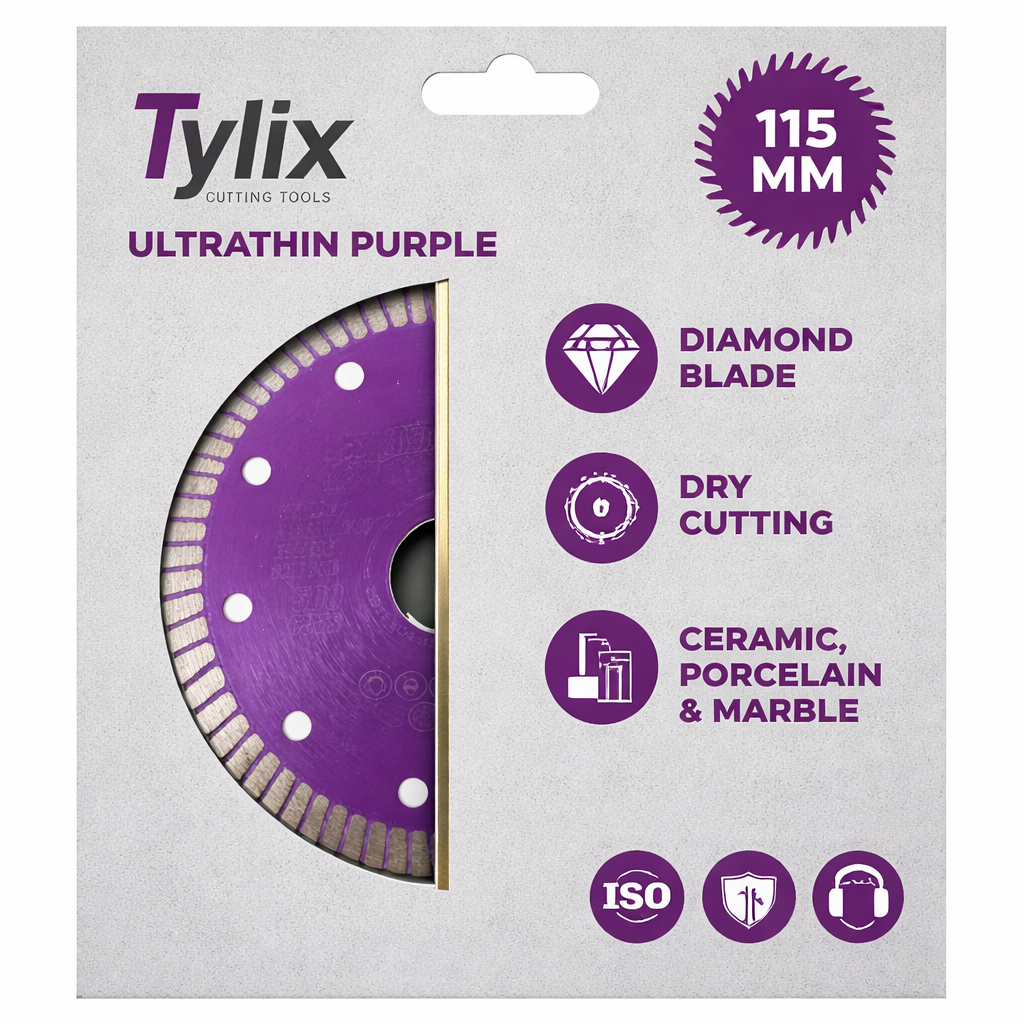
Tylix 115mm UltraThin Purple Diamond Disc Blade
The Tylix UltraThin Purple Diamond Blade, product code 6416, is another 115mm blade within the current range. Quantum lists it for hard materials including porcelain, ceramic and granite, with a maximum speed of 13,300 RPM. Quantum Group NI
It provides another option for installers who regularly need to cut dense tile and stone materials.
Product code: 6416
Diameter: 115mm
Suitable for: porcelain, ceramic and granite
Maximum RPM: 13,300
Internal link: Tylix UltraThin Purple Diamond Blade
What blade should you use with a wet tile saw?
Wet tile saws use water to help cool the blade and control dust while the tile is being cut. They are particularly useful for repetitive cutting and harder materials.
Quantum’s current cutting range also includes a 250mm Continuous Rim Diamond Blade, specifically listed for porcelain, with a 25.4mm bore. The DIAMOND3 Yellow Blade is a premium continuous-rim wet blade for porcelain and is available in 250mm and 300mm diameters. Quantum Group NI
These sit alongside Quantum’s DIAMOND3 wet saw tile cutter range. Quantum Group NI
They aren’t Tylix-branded products, but they are worth including in the guide because they answer a different cutting requirement from the smaller 115mm Tylix dry-cutting blades.
When should you use a diamond hole saw or tile hole cutter?
A straight tile cutter cannot help when the installation has to pass around pipework, shower fittings, taps or other circular penetrations.
For these jobs, a diamond hole saw — also commonly described as a diamond hole cutter — is designed to produce a controlled circular opening through hard tile materials.
Tylix Diamond Hole Cutters
Quantum’s current Tylix range includes vacuum-brazed diamond hole cutters for very hard ceramics, natural stone and porcelain. They use an M14 thread, and an adapter is available where required. Sizes from 6mm to 12mm are wax filled. View thw full range in our brochure here.
The current range covers:
| Tylix product code | Hole diameter |
|---|---|
| 0830.006 | 6mm |
| 0830.008 | 8mm |
| 0830.010 | 10mm |
| 0830.012 | 12mm |
| 0830.020 | 20mm |
| 0830.027 | 27mm |
| 0830.030 | 30mm |
| 0830.035 | 35mm |
| 0830.040 | 40mm |
| 0830.045 | 45mm |
| 0830.050 | 50mm |
| 0830.060 | 60mm |
| 0830.070 | 70mm |
| 0830.075 | 75mm |
| 0830.105 | 105mm |
| 0830.115 | 115mm |
| 1553 | M14 adapter |
That range means installers can select the diameter according to the opening required rather than trying to enlarge a small drilled hole manually.
When should you use a diamond tile drill bit instead of a hole cutter?
For smaller penetrations, a drill bit is generally more appropriate than a large hole cutter.
A common example would be drilling into porcelain for a fixing rather than producing a large opening for a pipe or fitting.
Tylix Wax Filled Drill Bits
The current Tylix Wax Filled Drill Bit range is designed for drilling hard materials such as porcelain. The wax helps reduce friction during drilling, which in turn helps prolong the life of the drill bit.
Current sizes are:
| Product code | Diameter |
|---|---|
| DDTD5 | 5mm |
| DDTD6 | 6mm |
| DDTD7 | 7mm |
| DDTD8 | 8mm |
| DDTD10 | 10mm |
| DDTD12 | 12mm |
Internal link: Tylix Wax Filled Drill Bits
For glass rather than porcelain, Quantum’s current cutting range also includes Heller Spear Shaped Drill Bits in 6mm, 8mm and 10mm sizes specifically for glass drilling. Quantum Group NI
What should you use for curves, mosaics and small adjustments?
Not every cut needs a powered machine.
Tylix Tile Nippers
The Tylix Tile Nippers use tungsten-carbide tips and are designed for nibbling and shaping ceramic tiles. They are particularly useful where small sections have to be removed gradually, including more detailed work and mosaics. Quantum currently lists the straight 215mm version under product code 1050. Quantum Group NI
Tile nippers are useful for:
- small adjustments;
- irregular edges;
- gradual curves;
- shaping ceramic tiles;
- mosaic work.
They should complement rather than replace the main tile cutter. Where a long, clean straight edge is required, use the appropriate cutter or blade first.
Internal link: Tylix Tile Nippers
Which tile cutting tool is best for ceramic, porcelain and natural stone?
There is no universal answer, but this provides a useful starting point.
| Material / job | Recommended type of tool | Quantum range to consider |
|---|---|---|
| Straight cut in ceramic | Manual tile cutter + cutting wheel | Compatible manual cutter/cutting wheel |
| Straight cut in suitable porcelain | Heavy-duty manual cutter or diamond cutting system | Cutting wheel or Tylix diamond blade |
| Dry cutting porcelain | Diamond blade | Tylix TTE115 / UltraThin Purple Blade |
| Ceramic, porcelain or granite powered cutting | Diamond disc | Tylix 115mm UltraThin Purple Blade |
| Wet cutting porcelain | Continuous-rim wet blade | Continuous Rim Blade / DIAMOND3 Yellow Blade |
| Small hole in porcelain | Diamond drill bit | Tylix Wax Filled Drill Bits |
| Circular pipe/fitting hole | Diamond hole cutter | Tylix Diamond Hole Cutters |
| Glass drilling | Glass-specific drill bit | Heller Spear Shaped Drill Bit |
| Small ceramic adjustments | Tile nippers | Tylix Tile Nippers |
| High-volume/demanding cutting | Wet saw | DIAMOND3 Wet Saw Tile Cutter |
Always check the tile manufacturer’s recommendations and the specification of the cutter, blade or drill being used before starting work.
How can you reduce chipping when cutting porcelain tiles?
Porcelain is dense, so blade selection and cutting technique matter.
Start with a blade specifically intended for porcelain and confirm that its diameter, bore, maximum speed and wet/dry specification are compatible with the machine.
For powered cutting, avoid forcing the tile through the blade. A controlled feed helps the blade work as designed. If the finished edge will remain visible, prioritise cut quality rather than simply choosing the fastest cutting method.
For drilling and circular openings, select a diamond bit or hole cutter of the correct diameter rather than attempting to create the opening through several overlapping cuts.
Appropriate eye, hearing and respiratory protection should be used, and dust should be controlled in accordance with the tool manufacturer’s instructions and site requirements.
Is a diamond hole saw the same as a diamond drill bit?
They perform closely related jobs, but size and application are different.
A diamond drill bit is normally used for smaller holes such as fixings. A diamond hole saw or hole cutter creates a larger circular opening, for example around pipework, valves or other services.
The Tylix range reflects this distinction: wax-filled drill bits are currently available from 5–12mm, while the diamond hole cutters cover diameters from 6mm through to 115mm. Quantum Group NI
What tile cutting tools should a professional tiler keep in their kit?
Rather than relying on one cutter for every material, a useful professional setup combines several cutting methods.
For day-to-day work, that could mean a quality manual cutter and cutting wheel for straight cuts, a 115mm diamond blade for difficult porcelain and detailed powered cuts, diamond drill bits for fixing holes, several commonly used diamond hole cutter sizes for pipework, and tile nippers for finishing and irregular shaping.
For larger projects or repeated work on dense porcelain and stone, a wet tile saw can then provide the additional cutting capacity required.
That combination allows the tool to be chosen according to the job rather than compromising the tile to suit the tool.
Tylix tile cutting tools from Quantum Group
Tylix forms part of Quantum Group’s wider range of tiling tools and accessories supplied through retailers, wholesalers, builders’ merchants and online retailers across the UK and Ireland. Quantum operates on a wholesale trade-only basis rather than selling directly to the end user. Quantum Group NI
For the cutting and drilling stage of an installation, the verified current Tylix range includes:
- Tylix TTE115 Ultrathin Pro Blade
- Tylix 115mm UltraThin Purple Diamond Disc Blade
- Tylix Wax Filled Drill Bits – 5, 6, 7, 8, 10 and 12mm
- Tylix Diamond Hole Cutters – 6mm to 115mm
- Tylix M14 Adapter
- Tylix Tile Nippers
The wider Quantum cutting range also includes wet saw cutters and blades, manual cutter accessories and specialist glass drilling products. Quantum Group NI
Looking for a Tylix stockist? Contact Quantum Group and the team can help you find your nearest stockist in the UK or Ireland. Retailers, wholesalers and merchants can also contact Quantum about stocking the range.