

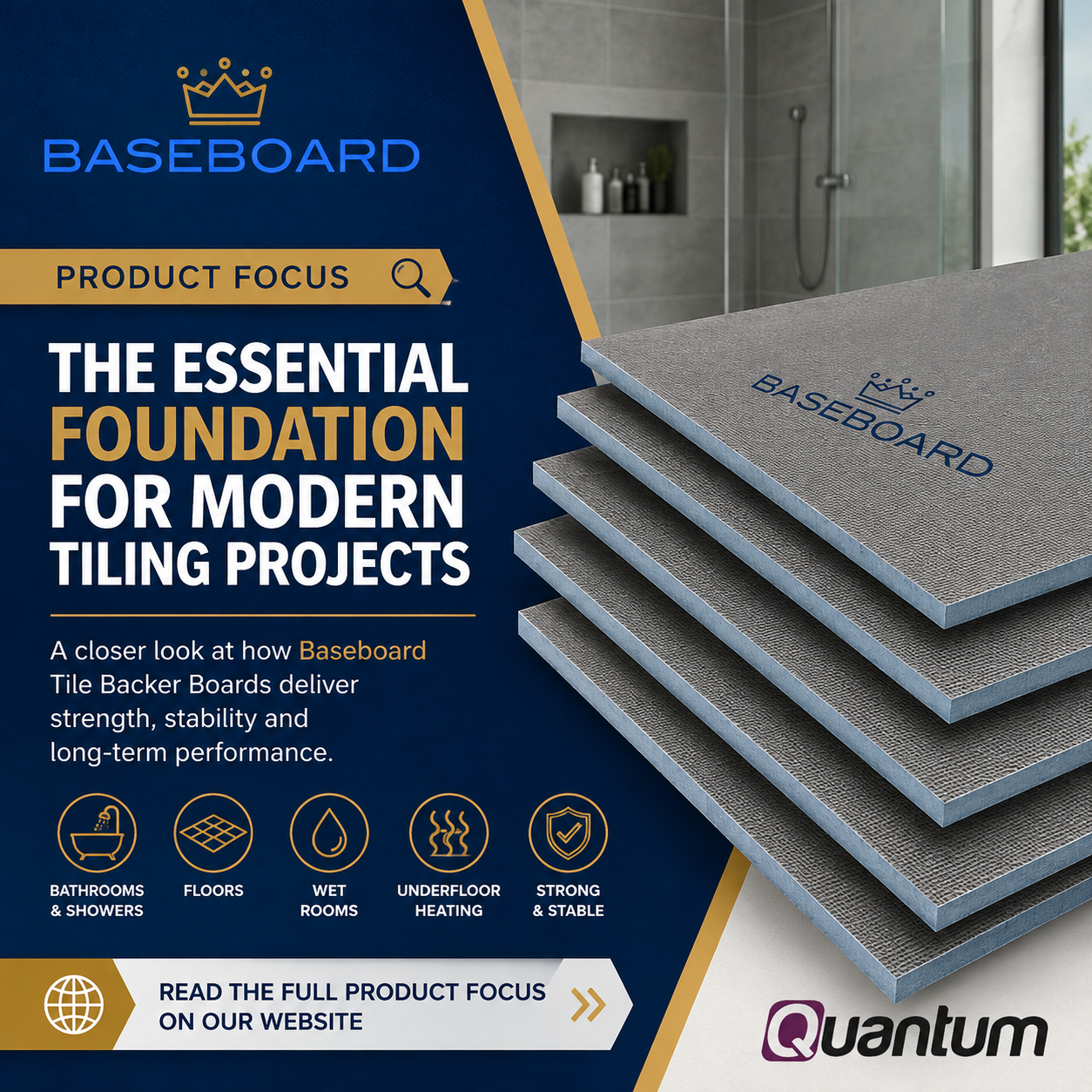
Baseboard is a lightweight, waterproof tile backer board designed to create a stable, insulating and tile-ready substrate for walls and floors. Suitable for bathrooms, showers, wet rooms, underfloor heating and a wide range of residential and commercial tiling projects, it provides a practical alternative to moisture-sensitive substrates such as plasterboard, plywood and chipboard.
A successful tiled installation starts long before the first tile is fixed. The tiles, adhesive and grout may create the visible finish, but the performance and longevity of that finish depend heavily on the surface beneath it.
If the substrate moves, absorbs moisture, deteriorates or is unsuitable for the weight and demands of the tiled finish, problems can develop later. Cracked grout, loose tiles, moisture damage and costly remedial work can all have their origins beneath the surface.
This is why purpose-designed tile backer boards have become such an important part of modern tiling.
Baseboard provides installers with a stable, waterproof and insulating substrate designed specifically for tiling. Whether the project involves a bathroom wall, a tiled timber floor, a shower enclosure, a wet room or electric underfloor heating, Baseboard helps create the dependable foundation needed for a professional installation.
In this product guide, we take a detailed look at what Baseboard is, why tile backer boards are used, where Baseboard can be installed, its advantages over traditional substrates and how it forms part of a complete waterproof tiling system.
What is Baseboard tile backer board?
Baseboard is a purpose-designed waterproof tile backer board that creates a strong, stable surface onto which ceramic, porcelain, natural stone and mosaic tiles can be installed. It is suitable for wall and floor applications and can be used with timber and metal studwork as well as suitable existing walls and floors.
Unlike general-purpose construction boards that have subsequently been adapted for tiling, a tile backer board is designed specifically to deal with many of the conditions encountered beneath tiled finishes.
Baseboard combines a lightweight insulating core with cement-coated surfaces and strengthened fibreglass mesh. This creates a rigid, tile-ready panel that is straightforward to transport, cut and position while still providing the stability required beneath tiles.
The boards are also impervious to moisture. This makes Baseboard particularly useful in bathrooms, showers, wet rooms and other areas where the substrate may regularly be exposed to moisture.
The result is a versatile board that can perform several important functions within one tiling system: it provides the surface onto which tiles are fixed, helps protect vulnerable construction materials from moisture and provides thermal insulation where required.
Why does the substrate matter when tiling?
Tiles need a flat, stable and suitable substrate. If the surface beneath the installation moves, deteriorates or is affected by moisture, that weakness can eventually be transferred through the adhesive and into the tiled finish.
It is easy to focus almost entirely on the tiles when planning a project. After all, they are what the customer ultimately sees. However, experienced installers know that substrate preparation can have just as much influence over the finished result.
Tiles and grout form a relatively rigid surface. They cannot simply flex indefinitely with a moving floor or unstable wall. If significant movement occurs beneath the installation, stresses can be transferred through the adhesive bed and eventually present themselves as cracked grout, debonded tiles or other failures.
Moisture presents another challenge. Bathrooms and showers inevitably contain water and high levels of humidity. If moisture reaches a sensitive substrate and causes it to soften, swell or distort, the tiled surface attached to it may also become compromised.
Using a purpose-designed tile backing board helps create a more predictable surface before the tiling process begins.
Rather than expecting the adhesive or tiles to compensate for weaknesses beneath them, installers can tackle substrate preparation as a separate and essential part of the overall system.
Why use Baseboard instead of plywood, chipboard or plasterboard?
Baseboard is specifically designed as a tiling substrate and is impervious to moisture, whereas common construction materials such as chipboard, plywood and standard plasterboard can be vulnerable when exposed to water or unsuitable movement.
Traditional substrates have been used beneath tiles for many years, but that does not mean they are always the best choice for a modern installation.
Plasterboard
Plasterboard is widely used for internal walls because it is economical and straightforward to install. However, standard plasterboard should not be treated as a waterproof substrate.
This becomes particularly important in showers and other areas that experience repeated direct water exposure. If moisture reaches a vulnerable board or the construction behind it, deterioration can occur out of sight.
Plywood and chipboard
Timber-based sheets create a different set of challenges. Timber naturally responds to changes in moisture and environmental conditions, and movement within the substrate can create stresses in the tiled finish.
Chipboard is especially vulnerable to prolonged moisture exposure. Once water penetrates the material, swelling and deterioration can significantly affect the stability of the surface.
A purpose-designed alternative
Baseboard is intended to overcome these problems by creating a consistent substrate specifically for tiling.
Its waterproof construction means the panel itself will not absorb water in the same way as moisture-sensitive building boards. Its reinforced cement-coated surfaces also provide the stable tile-ready finish required for modern ceramic, porcelain, stone and mosaic installations.
Using a dedicated tile backer board therefore helps remove unnecessary uncertainty from the substrate before the tiles are installed.
Is Baseboard waterproof?
Yes. Baseboard panels are impervious to moisture. However, a waterproof tile backer board should still be incorporated into a correctly detailed waterproofing system in showers, wet rooms and other areas exposed to significant amounts of water.
This distinction is important.
A waterproof board prevents water from passing through the body of the panel, but a completed wall or floor contains much more than the flat surface of the board. There are also board joints, internal corners, changes of plane, fixings and pipe penetrations.
These areas must be treated appropriately if the aim is to create a fully waterproof tiled installation.
Baseboard is therefore particularly effective when combined with the AquaTank tanking system. Together, they can be used to create a protected surface beneath ceramic, porcelain, natural stone and mosaic tiles.
This system-led approach is preferable to assuming that tiles and grout alone will provide all of the waterproofing required.
Do you need to waterproof tile backer board before tiling?
The Baseboard panel itself is waterproof, but joints, corners and penetrations still need appropriate treatment in areas such as showers and wet rooms. A compatible tanking system can be used to create continuous waterproof protection beneath the tiles.
One of the most common misunderstandings surrounding waterproof tile backer boards is the belief that once the boards have been fixed, every part of the installation is automatically waterproof.
In reality, water will naturally seek out vulnerable details. The meeting point between two boards, the junction between a wall and floor, or the hole created for a pipe can all provide routes around an otherwise waterproof panel.
For this reason, waterproofing should be considered as a system rather than an individual product.
Combining Baseboard with AquaTank allows these vulnerable areas to be addressed as part of the overall installation, helping prevent moisture from travelling through the build-up and reaching the structure behind it.
This is especially important in walk-in showers, wet rooms, steam rooms and other areas subject to significant or repeated water exposure.
Is Baseboard a good tile backer board for showers?
Yes. Baseboard is particularly well suited to shower installations because it is waterproof, stable and ready to tile. When the board joints, corners and penetrations are correctly waterproofed, it can form part of a complete protected shower substrate.
Showers are among the most demanding tiled areas in any residential or commercial building.
A shower wall can experience direct water exposure every day, while the area around the tray, corners, valves and pipe penetrations creates multiple potential points of vulnerability.
Using a waterproof tile backer board for a shower helps ensure the substrate itself is capable of coping with these conditions.
Baseboard provides an alternative to using moisture-sensitive boards behind the tiles. Its lightweight format also makes installation more manageable where boards need to be cut around shower controls, pipework or niches.
For complete shower and wet room installations, Baseboard can also be combined with preformed Baseboard shower trays and an appropriate tanking system.
Can Baseboard be used in a wet room?
Yes. Wet rooms are one of the principal applications for Baseboard. Panels can be used to create stable, waterproof wall and floor substrates, while preformed Baseboard shower trays provide a tile-ready shower area with the required fall towards the drain.
Wet rooms place particularly high demands on the substrate because water is not contained within a conventional raised shower tray.
Instead, the room itself forms part of the showering area. Careful preparation, waterproofing and drainage are therefore essential.
Baseboard can be incorporated into both wall and floor construction to create a consistent substrate throughout the wet area.
The Baseboard range also includes preformed shower trays. These cement-coated, fibreglass-reinforced trays incorporate a preformed fall towards the drain, helping installers create a level-access tiled shower area without needing to form the fall entirely from scratch.
When the panels, shower tray and appropriate waterproofing components are correctly combined, they provide a practical system for modern wet room construction.
Can you use tile backer board on floors?
Yes. Baseboard can be used as a floor tile backer board on suitable timber and concrete floor constructions, helping create a stable, tile-ready surface before ceramic, porcelain or stone tiles are installed.
Floor installations present different challenges from walls.
A tiled floor has to cope with regular foot traffic, furniture, point loading and any movement present within the underlying floor structure. On timber floors in particular, excessive flex can create stresses that a rigid tile finish is poorly equipped to accommodate.
Installing an appropriate floor tile backer board can help create a stronger and more consistent surface before tiling.
Baseboard can also be useful when working with suitable existing floors during refurbishment. Rather than attempting to correct every issue using the tile adhesive itself, the board provides a defined preparation layer onto which the finished tiling system can be installed.
The exact installation method and board thickness should always be selected according to the condition and construction of the floor rather than assuming one approach is appropriate for every project.
Can Baseboard be used on walls?
Yes. Baseboard is suitable as a tile backer board for walls and can be installed on suitable timber or metal studwork as well as appropriate existing wall surfaces.
Wall substrates need to provide more than moisture resistance. They also need to create a suitable, stable surface capable of supporting the intended tiled finish.
This has become increasingly important as larger porcelain tiles and heavier decorative finishes have grown in popularity.
Baseboard’s lightweight design makes the panels straightforward to position on walls, while the cement-coated reinforced surface provides the tile-ready substrate required once installation is complete.
It can therefore be used for bathroom walls, shower enclosures, wet rooms and other wall tiling applications where a purpose-designed substrate is preferred over conventional boards.
Can you use Baseboard with underfloor heating?
Yes. Baseboard has high thermal insulation properties and is suitable for use beneath electric underfloor heating, helping minimise unwanted heat transfer into adjacent surfaces.
Underfloor heating works most effectively when as much useful heat as possible is directed upwards through the finished floor.
If electric heating is installed over an uninsulated substrate, a proportion of the energy can initially travel downwards into the floor construction rather than towards the room.
An insulating tile backer board provides a thermal break between the heating system and the substrate.
Baseboard’s insulating properties make this one of its key applications. By helping reduce heat transfer to adjacent surfaces, it can support a more responsive underfloor heating installation while simultaneously providing the stable substrate needed beneath the tiled finish.
This combination of insulation and tile preparation within one panel can also simplify the overall floor build-up.
What thickness of Baseboard do you need?
Baseboard is available in 4mm, 6mm, 10mm, 12mm and 20mm thicknesses, with panels measuring 1200 x 600mm. The correct thickness depends on the application, substrate, available build-up and level of insulation or support required.
There is no single tile backer board thickness that is automatically right for every project.
A refurbishment where maintaining existing floor levels is critical may have very different requirements from a new wet room or an installation incorporating underfloor heating.
Factors that should be considered include:
- Whether the board is being installed on a wall or floor
- The type and condition of the underlying substrate
- Available floor or wall build-up
- The amount of additional insulation required
- Whether underfloor heating will be incorporated
- The demands of the finished tiled installation
Rather than simply selecting the thickest board available, the aim should be to choose the thickness appropriate to the complete build-up.
Quantum Group’s Baseboard range is available in 4mm, 6mm, 10mm, 12mm and 20mm, providing options for a broad variety of residential and commercial projects.
For more detailed advice, see our Choosing the Right Thickness of Baseboard for Your Project guide.
Is Baseboard a lightweight tile backer board?
Yes. Baseboard has been designed to combine a strong, reinforced tile-ready surface with a lightweight construction that makes the panels easier to transport, handle, position and cut on site.
Practicality is an important consideration when choosing building materials.
Heavy boards can be awkward to move around a project, particularly when working upstairs, inside smaller bathrooms or across larger commercial installations. They can also increase the physical effort involved in repeatedly measuring, positioning and fixing panels.
Baseboard provides the strength and stability required from a tiling substrate without unnecessary weight.
Its lightweight design makes it easier for installers to manoeuvre panels into place and can speed up preparation across larger projects. It also means Baseboard does not introduce the same level of additional load associated with much heavier construction panels.
How do you cut Baseboard tile backer board?
Baseboard is designed to be straightforward to cut and shape on site, making it easier to fit around corners, pipework and other details without requiring complicated specialist equipment.
Very few bathrooms or wet rooms consist entirely of uninterrupted rectangular surfaces.
Installers regularly need to cut around pipes, valves, recessed niches, corners, drains and room dimensions that are not perfectly square.
Ease of cutting therefore makes a real difference to installation efficiency.
The lightweight construction of Baseboard allows panels to be measured, marked and shaped as required before they are fixed. This also makes it suitable for refurbishment work where installers may need to accommodate an existing layout rather than working within a completely new structure.
Accurate cutting remains important. Boards should be measured carefully and dry-fitted where appropriate before final fixing so that joints, edges and penetrations can subsequently be detailed correctly.
For a more detailed explanation, see our Cutting & Shaping Baseboard: A Quick Guide.
How do you install tile backer board?
Tile backer board installation involves preparing the underlying substrate, selecting the appropriate board, cutting the panels to size, securely fixing them and correctly treating joints and waterproofing details before tiling begins.
The precise fixing method will depend on whether Baseboard is being installed on a wall, floor, timber construction, metal studwork or another suitable substrate.
However, the overall principle remains the same: the boards need to form a secure and suitably stable surface without unwanted movement.
Before installation begins, the underlying structure should be assessed. A backer board should not be expected to disguise serious structural instability or compensate for a fundamentally unsuitable base.
Boards can then be measured and cut to fit the area before being installed using the appropriate fixing method for the substrate.
Particular attention should be paid to joints, corners and penetrations, especially in wet environments. These details should form part of the waterproofing strategy rather than being left untreated simply because the board itself is waterproof.
Once the substrate has been correctly prepared and any necessary waterproofing completed, the surface is ready for the chosen tiling system.
For detailed instructions, see our Step-by-Step Guide: Fixing Tile Backer Board to Your Wall and Floor.
What are the main benefits of Baseboard?
Baseboard combines waterproofing, stability, insulation, versatility and lightweight handling within one tile backer board system. This makes it suitable for a broad range of professional wall and floor tiling applications.
- Waterproof construction
The panels are impervious to moisture, helping protect the construction behind the tiled surface.
This is particularly valuable in showers, bathrooms, wet rooms, steam rooms and similar environments.
- Stable tile-ready surface
The cement-coated, fibreglass-reinforced construction creates a dependable substrate for ceramic, porcelain, natural stone and mosaic tiles.
- Thermal insulation
Baseboard offers high thermal insulation properties, helping reduce heat transfer to adjacent surfaces and making it particularly useful beneath electric underfloor heating.
- Lightweight installation
The boards are easy to handle and cut, helping simplify site preparation without sacrificing the stability required from the substrate.
- Versatile applications
Baseboard can be used on walls and floors and is suitable for timber and metal studwork as well as appropriate existing surfaces.
- Range of thicknesses
With 4mm, 6mm, 10mm, 12mm and 20mm panels available, installers can choose a product appropriate to different project requirements.
- Part of a wider system
Baseboard can be combined with preformed shower trays and AquaTank waterproofing products, allowing installers to create an integrated system rather than sourcing unrelated individual components.
Where can Baseboard tile backer boards be used?
Baseboard is suitable for a wide range of residential and commercial tiled environments, particularly where moisture protection, substrate stability or thermal insulation are required.
Applications can include:
- Bathrooms and en-suites
- Shower walls and enclosures
- Walk-in showers
- Wet rooms
- Tiled walls
- Tiled floors
- Timber and metal studwork
- Electric underfloor heating installations
- Steam rooms
- Swimming pool environments
- Residential refurbishments
- Commercial washrooms and leisure environments
The suitability of Baseboard across different applications means retailers can offer one recognisable system for many of the substrate-related questions installers encounter.
Baseboard for commercial tiling projects
Baseboard can also be specified across suitable commercial tiling applications where a stable, waterproof and durable substrate is required.
Commercial environments can place additional demands on a tiled installation.
Hotel bathrooms, leisure facilities, changing areas, washrooms and similar spaces may experience more frequent use and cleaning than a typical domestic bathroom. This makes correct substrate preparation particularly important.
A failure beneath a commercial tiled finish can also be significantly more disruptive. Remedial work may require areas to be closed, tiles removed and multiple stages of the installation reconstructed.
Using a purpose-designed substrate from the beginning helps address potential weaknesses before the finished surface is installed.
Baseboard’s combination of waterproof performance, reinforced construction and lightweight handling makes it a practical option for contractors and installers working across demanding tiled environments.
Baseboard shower trays for complete wet room installations
The Baseboard range extends beyond flat tile backer panels.
Preformed Baseboard shower trays provide a waterproof, tile-ready foundation for walk-in showers and wet rooms, incorporating a preformed fall towards the drain.
Creating an accurate shower fall manually requires careful preparation. If the gradient is incorrect, water may pool rather than drain effectively.
A preformed tray simplifies this part of the installation by incorporating the required fall into the product itself.
Baseboard shower trays are cement coated and reinforced with fibreglass mesh, providing a surface ready to be integrated into the wider waterproofing and tiling system.
With different tray dimensions, drain positions and configurations available, the range provides installers with options for a variety of bathroom and wet room layouts.
Baseboard and AquaTank: creating a complete waterproof system
A high-quality waterproof installation depends on more than one component.
Although Baseboard panels themselves are impervious to moisture, areas such as joints, corners and penetrations must still be correctly incorporated into the waterproofing system.
This is why Baseboard works particularly well alongside AquaTank.
AquaTank can be used to seal vulnerable details and create continuous waterproof protection beneath the tiled finish. This allows the backer board, waterproofing components and tiles to function as a coordinated system rather than relying upon tiles and grout alone to manage water.
For retailers, this also provides an opportunity to supply customers with everything required for the substrate and waterproofing stages of the project instead of treating each product as an isolated sale.
Frequently Asked Questions About Baseboard Tile Backer Boards
Is tile backer board waterproof?
Some tile backer boards are waterproof and others may require additional waterproofing, so the individual product specification should always be checked. Baseboard panels are impervious to moisture, but joints, penetrations and other vulnerable details still need to be correctly treated in wet areas.
Do I need tile backer board in a shower?
A purpose-designed waterproof substrate is highly beneficial in a shower because the area experiences frequent direct water exposure. Baseboard can be used as the tile backer board within a correctly waterproofed shower installation.
Can you put tile directly onto Baseboard?
Baseboard is designed to create a tile-ready surface. Tiles should be installed using the appropriate tiling products and methods for the specific tile type, environment and overall installation.
Can tile backer board be used on a floor?
Yes. Baseboard is suitable for appropriate floor installations as well as walls. The underlying floor needs to be suitable and the correct board thickness and fixing method should be selected for the application.
Can Baseboard be used over timber floors?
Baseboard is suitable for use with timber floor constructions, subject to correct substrate assessment and installation. It provides a stable tiling surface and can help address some of the challenges associated with tiling onto timber-based substrates.
Can Baseboard be used with underfloor heating?
Yes. Its thermal insulation properties make Baseboard particularly suitable for use beneath electric underfloor heating.
What sizes are Baseboard panels?
Baseboard panels measure 1200 x 600mm and are available in 4mm, 6mm, 10mm, 12mm and 20mm thicknesses.
What tiles can be fitted to Baseboard?
Baseboard can provide a substrate beneath ceramic, porcelain, natural stone and mosaic tiled finishes, subject to the correct installation products being selected for the project.
Is a waterproof backer board enough for a wet room?
The board is only one element of the waterproofing system. Joints, corners, penetrations and transitions also require appropriate waterproofing. Baseboard can be combined with AquaTank to create a complete protected surface beneath the tiles.
Why Choose Baseboard?
The performance of a tiled wall or floor begins beneath the surface.
Choosing an unsuitable substrate can introduce unnecessary risks into an otherwise high-quality installation. Moisture-sensitive materials, inadequate preparation or excessive movement can all compromise the finished surface over time.
Baseboard provides a purpose-designed alternative.
Its combination of waterproof performance, cement-coated fibreglass reinforcement, thermal insulation, lightweight handling and multiple thickness options provides installers with a versatile substrate for modern wall and floor tiling.
Whether the project involves a straightforward bathroom refurbishment, a waterproof tile backer board for a shower, preparation of a timber floor, a wet room system or an electric underfloor heating installation, Baseboard provides the foundation on which the remaining tiling system can be built.
For tile retailers, stocking a complete system also makes it easier to help customers select the right products at every stage of a project — from preparation and waterproofing through to the finished tiles and accessories.
Baseboard from Quantum Group
Quantum Group is a wholesale supplier of tiles, tiling accessories and professional installation systems to retailers throughout the UK and Ireland.
Our Baseboard range gives retailers access to a versatile tile backer board system designed for the requirements of modern residential and commercial tiling.
With 4mm, 6mm, 10mm, 12mm and 20mm Baseboard panels, preformed shower trays and compatible waterproofing solutions available, retailers can offer their customers a complete approach to substrate preparation rather than a single standalone product.
Combined with Quantum Group’s extensive range of tiles and tiling accessories, reliable stockholding and next-day delivery service, Baseboard helps our retail partners provide installers with the products they need to complete projects correctly from the substrate upwards.
Looking to stock Baseboard or need help choosing the right system for your customers? Contact the Quantum Group sales team to find out more about the Baseboard range or to locate your nearest stockist.