

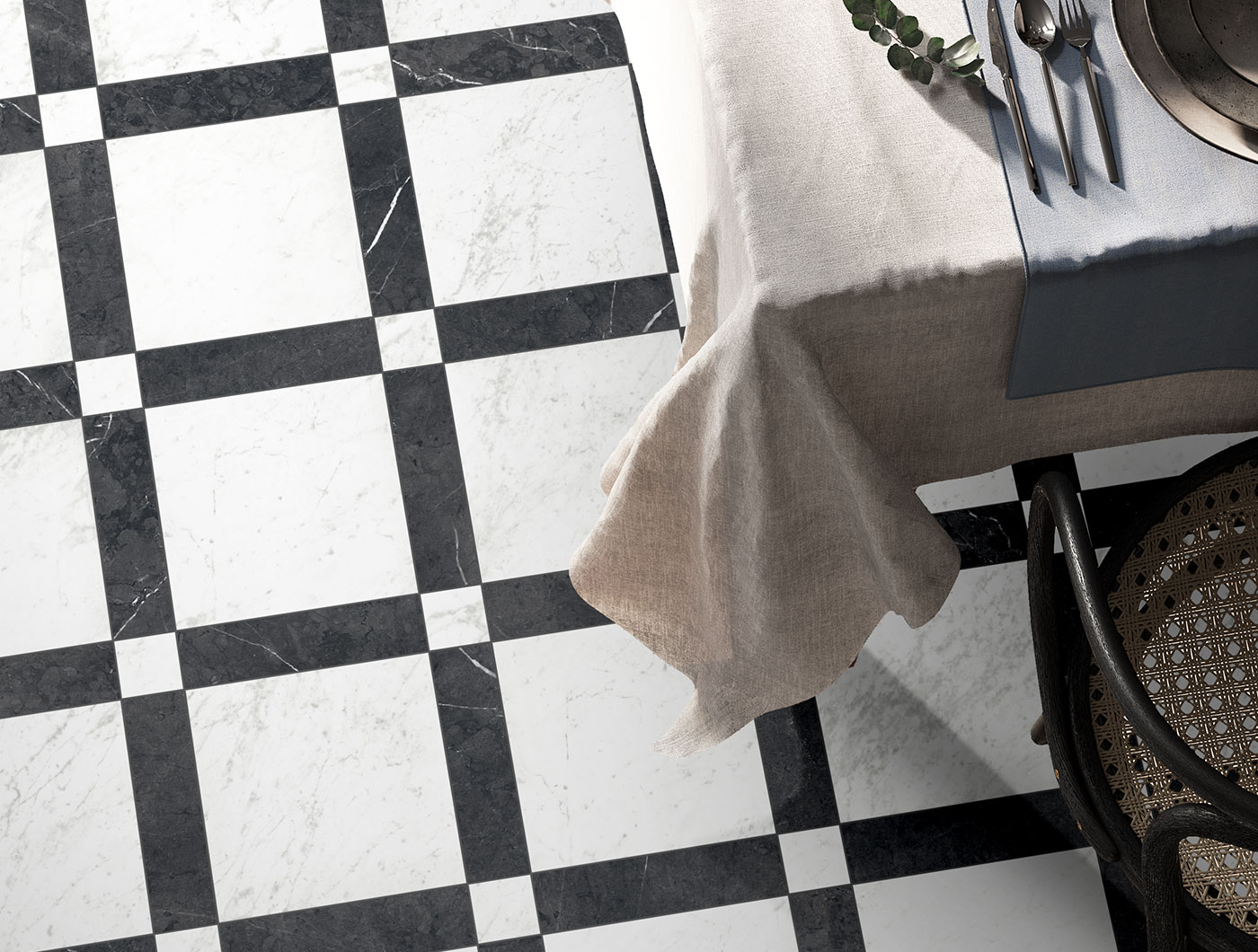
The tile market in 2027 will not be driven by one colour, size or finish, as different parts of the market are moving in different directions. Renovators and self-builders are increasingly looking for warmer stone effects, larger formats and more distinctive finishes, while volume residential projects remain focused on value, consistency and practical ceramic ranges. Commercial spaces add another set of requirements altogether.
For tile retailers, the opportunity is to build a range that reflects how and where tiles are actually being bought.
What is changing in the tile market for 2027?
There are two trends retailers need to consider:
The first is design.
Warm stone, limestone, travertine influences, softer marble, timber, texture, large formats, more expressive colour and indoor-outdoor continuity are all influencing tile design going into 2027.
The second is project type.
The tile chosen for a one-off £20,000 bathroom renovation is unlikely to be the same tile being specified across 80 apartments.
Likewise, the requirements of a hotel reception, a developer bathroom and a homeowner replacing an en-suite are very different.
That means the right question for a retailer isn’t simply:
“What tiles are fashionable?”
It is:
“What types of projects are our customers buying for, and do we have the right ranges for each?”
2027 tile opportunities
| Market | What matters most | Tile direction | Navarro ranges to consider |
|---|---|---|---|
| Volume residential | Price, repeatability, availability, easy installation, broad appeal | Ceramic wall tiles, simple stone/marble looks, practical neutral floors | Lingstone, Vespa Gold, Zero, Arkety, Capri, |
| Residential refurbishment | Design, individuality, premium feel | Warm stone, marble, texture, large format, wood | Block, Dolomio, Capri, Hambleton, Legno, Manor, Norway, Pietra Tramonto |
| Luxury renovation/self-build | Statement finish, quality, larger spaces | Large format, Italian porcelain, marble, onyx, distinctive stone | Dolomio, Block, Classic Marble, Regency Marble, Iceland, Labradorite, Pietro Tramonto Slab |
| Commercial & hospitality | Durability, design, repeat specification | Cement, stone, large format, feature surfaces | Arkety, Zero, Hambleton, Block, Iceland, Labradorite |
| Design-led feature areas | Personality and showroom impact | Colour, pattern, decorative surfaces, artisanal finishes | Iceland, Labradorite, Classic Marble |
The important point is that not every range needs to suit every market.
A strong tile portfolio needs commercial products that can win volume as well as ranges that give a showroom personality and margin.
1. Volume residential: value and repeatability come first
Volume residential needs to be treated differently from high-end renovation.
When a developer, contractor or large residential scheme is buying across multiple bathrooms or properties, decisions tend to become much more commercially driven.
They need products that are:
cost-effective;
easy to repeat across multiple plots;
straightforward to install;
broadly appealing;
available in useful quantities;
and unlikely to polarise buyers.
This is where ceramic wall tiles remain particularly important.
Large-format premium Italian porcelain may look fantastic in a showroom, but it will not necessarily be the right commercial answer for a development with dozens or hundreds of bathrooms.
Lingstone Wall
 Lingstone Wall is a good example of the type of range that can work across a more commercially driven residential market.
The wall collection uses red-body ceramic with a matt finish and combines plain and decorative options in a soft Burlington-stone-inspired design.
That allows a developer or retailer to achieve the warm, natural look that customers increasingly want without moving automatically into a premium porcelain specification.
It also demonstrates an important distinction for 2027:
the design trend can be premium even when the product specification needs to remain commercial.
A warm stone look can therefore work in both a luxury refurbishment and a volume housing scheme — but the products used to deliver the look may be completely different.
Vespa Gold
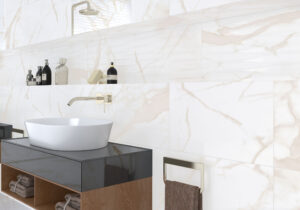 Vespa Gold provides another ceramic option.
The 250 × 700mm gloss wall tile combines a marble effect with gold veining and is available in plain and decorative versions.
For larger residential schemes, ceramic marble-effect wall tiles can provide the visual impression of a more expensive material while remaining more appropriate for cost-conscious bathroom specifications.
That makes this type of range relevant for:
apartments;
housing developments;
rental schemes;
and upgrade bathroom packages.
2. Volume residential
One of the mistakes retailers can make is assuming that a commercially priced tile must look basic.
That is becoming less true as manufacturing improves.
The volume market still follows broader design trends — it simply needs those trends translated into commercially viable products.
For 2027 that could mean:
warm beige rather than cold grey;
stone effect rather than flat colour;
subtle marble instead of highly dramatic veining;
and decorative options used selectively rather than across an entire room.
That gives retailers an opportunity to present developers with a good / better / best structure.
For example:
a core ceramic specification;
a more design-led ceramic upgrade;
and then a porcelain upgrade for higher-value plots.
That is likely to be far more commercially useful than presenting the same premium range to every project.
That makes warm neutrals, simple stone effects and understated contemporary surfaces particularly useful.
Lingstone
Lingstone can span this market well because its stone-inspired appearance feels current without becoming excessively trend-led.
A neutral stone range is easier to coordinate with different kitchen colours, bathroom furniture and sanitaryware, which is important when homes are being sold to buyers with very different tastes.
Zero
 Zero provides another useful contemporary option.
Its smooth cement-effect porcelain comes in a practical 608 × 608mm rectified format and includes Arena, Ceniza, Perla and Taupe shades.
Importantly, the cement look is moving away from the cold industrial greys that dominated several years ago.
Warmer taupe and sand-influenced surfaces make cement effects easier to use in mainstream interiors.
Arkety
Arkety serves a similar contemporary customer but offers a more architectural cement-inspired look.
With grey, light grey, white and warmer Marfil-style options, it can work particularly well where the brief calls for something modern but not decorative.
These types of ranges are useful for new-build because they can move between bathrooms, kitchens and open-plan floors without forcing the whole house into a particular aesthetic.
4. Residential refurbishment is where customers become more adventurous
Renovation is a very different sale. A homeowner renovating their own bathroom is often willing to spend more per square metre because the area is relatively small and they are making a personal design decision. This is where retailers can introduce more:
Italian porcelain;
large-format tiles;
texture;
premium stone effects;
special layouts;
wood effects;
and distinctive finishes.
For Quantum and Navarro, this is where many of the more design-led ranges really come into their own.
5. Warm stone will be one of the strongest renovation directions
One of the clearest changes in interior design is the move away from flat cool grey.
Warm limestone, beige, sand, almond and softer mineral colours are becoming increasingly important.
That does not necessarily mean a return to traditional beige bathrooms.
The new direction is much more natural and sophisticated.
Think:
limestone;
travertine;
aged Mediterranean stone;
warm mineral surfaces;
timber furniture;
brushed brass or bronze;
and softer, layered neutral schemes.
Block
 Block is particularly relevant here.
This premium Italian porcelain collection recreates the look of limestone in Grey, Beige and White, with matt finishes, rectified edges and large-format options including 600 × 600mm, 600 × 900mm and 800 × 800mm.
This is much more naturally positioned towards:
premium renovation;
self-build;
larger bathrooms;
open-plan living;
and design-led commercial work.
It is the type of range that can help a showroom move customers away from seeing beige as dated and towards seeing warm limestone as contemporary.
Dolomio
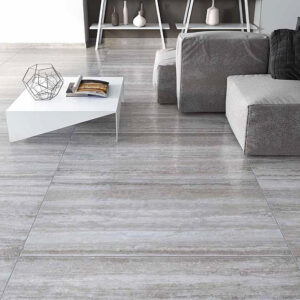 Dolomio pushes the same natural-material trend further.
The premium Italian porcelain range uses a vein-cut stone design in a 1220 × 610mm format, including White, Grey and warm Almond.
For 2027, Almond is particularly relevant.
Warm stone colours work exceptionally well with timber, brushed metal, neutral sanitaryware and spa-style bathrooms.
The decorative Nain and Jaipur options also allow retailers to add texture or a focal area without introducing a completely separate tile collection.
Hambleton
 Hambleton gives retailers another natural-stone direction.
Its 600 × 900mm matt porcelain format works particularly well in larger floors, kitchens and more substantial bathrooms.
Rather than selling all three ranges as simply “stone effect”, retailers could differentiate them:
Block – clean, refined limestone;
Dolomio – premium vein-cut contemporary stone;
Hambleton – more tactile natural-stone character.
That makes the showroom much easier for customers to navigate.
6. Mediterranean and aged-stone interiors will continue
Alongside refined limestone, there is also growing interest in interiors that look slightly more established.
This is where rustic and Mediterranean influences come in.
Rather than perfectly uniform surfaces, customers are embracing:
variation;
aged stone;
mixed formats;
warm earthy colours;
and layouts that feel less manufactured.
Pietra Tramonto
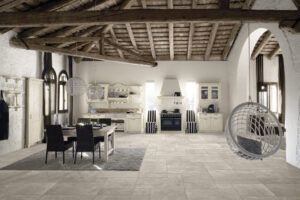 Pietra Tramonto fits this direction particularly well.
Its modular porcelain packs contain several different tile sizes, creating a more traditional stone-floor effect.
That makes it useful for:
kitchens;
renovated cottages;
garden rooms;
hallways;
extensions;
conservatories;
and indoor-outdoor projects.
It also gives a retailer something visually different from the rows of 600 × 600mm and 600 × 1200mm tiles that can dominate a showroom.
Pietro Tramonto Slab
For customers who want the same broader natural-stone story but at a more dramatic scale, Pietro Tramonto Slab can sit within the premium and design-led end of the showroom.
That gives the retailer an opportunity to present a trend at several levels rather than relying on one format.
7. Marble remains important — but there are several trend styles
Marble-effect tile is not disappearing in 2027.
But there isn’t one marble trend.
Some customers want:
classic Carrara;
others want warm gold veining;
some want highly polished luxury;
and others want more unusual coloured or decorative stone.
A retailer therefore benefits from having distinct marble propositions rather than five ranges that all look virtually identical.
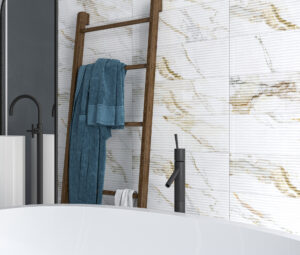
Vespa Gold – accessible marble
At the more accessible end, Vespa Gold gives customers the marble look in a ceramic wall format.
That makes it relevant not only to development projects but also budget-conscious bathroom refurbishment.
 Regency Marble – premium contemporary marble
Regency Marble moves further into the premium residential market.
It works particularly well for customers who want a luxurious bathroom without moving into the more dramatic coloured-stone looks.
Classic Marble – design-led Italian porcelain
 Classic Marble gives the trend another direction.
The Italian porcelain range is available in Carrara, Verde Alpi and Nero Marquina effects and includes 75 × 75mm, 75 × 300mm and 300 × 300mm formats.
That smaller-format approach is important.
The market isn’t moving exclusively towards bigger tiles.
Classic Marble allows:
checkerboard;
basketweave;
herringbone;
borders;
and more intricate layouts.
It therefore fits extremely well with the growing interest in individual, designer-led renovation.
8. Large format remains important at the premium end
Large-format porcelain will continue to be strongly associated with higher-end bathrooms and open-plan residential projects.
It creates:
fewer grout joints;
a more continuous surface;
a premium appearance;
and the ability to show stone and marble patterns across a larger area.
Within Navarro, ranges including Dolomio, Iceland, Labradorite, Block and larger-format options within Capri and Regency Marble give retailers several different routes into this market.
But they should be marketed primarily where they make commercial sense:
premium refurbishment;
self-build;
luxury residential;
high-spec developments;
hospitality;
and design-led commercial projects.
They are less likely to be the volume answer for a cost-sensitive multi-unit development.
9. Statement stone and colour are becoming more confident
Not every customer wants a beige bathroom.
Alongside the growth in warm neutrals is another movement towards very expressive surfaces.
Rather than using colour everywhere, customers are increasingly using a distinctive tile on:
one wall;
inside the shower;
behind a vanity;
in an entrance;
or as a commercial feature.
Iceland
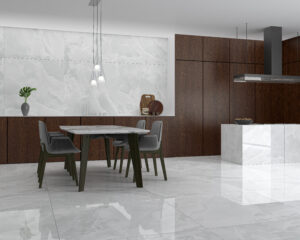 Iceland is one of the clearest Navarro examples.
Its 600 × 1200mm polished porcelain is inspired by onyx and available in Mint, Topaz, Midnight, White and Navy.
This is not a volume-development tile.
It is a showroom tile.
It gives customers a reason to stop, look and imagine something different.
Used correctly, products like Iceland can help a retailer create visual excitement even if the majority of actual sales remain in much safer neutrals.
Labradorite
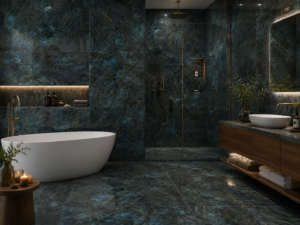 Labradorite takes statement stone even further.
Its large-format super-polished porcelain uses rich blue and iridescent mineral tones to create a very distinctive finish.
Again, its commercial role is not necessarily high-volume sales.
Its role can be to:
create showroom impact;
attract design-conscious customers;
support premium renovations;
and provide an option for feature walls and hospitality spaces where something unusual is required.
A showroom needs products that sell regularly and products that make people remember the showroom.
Those are not always the same ranges.
10. Wood-effect porcelain continues — but it is becoming more design-led
Wood-effect tiles remain useful because they combine the warmth customers associate with timber with the practicality of a tiled surface.
But the trend is becoming more sophisticated than simply putting a standard wood plank across a floor.
Legno
offers a long 1200 × 200mm plank format and works well in spaces where customers want a more traditional timber-floor appearance.
Norway
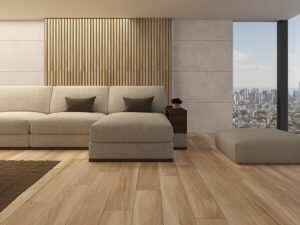 Norway adds another level.
Alongside 200 × 1200mm wood planks, the collection includes larger decorative relief panels.
That makes Norway particularly relevant to the trend for texture and architectural wall surfaces.
A showroom could use the plain floor tile and decorative wall element together to create a complete roomset.
Manor
 Manor offers a smaller 80 × 442mm wood-effect porcelain plank.
That format makes it particularly interesting for patterned installations such as herringbone and other decorative layouts.
This reflects another important 2027 direction:
layout itself is increasingly becoming part of the design.
Customers aren’t only choosing a tile. They are choosing how the tile will be arranged.
11. Texture and craft will remain important
Highly uniform, digitally perfect surfaces are being balanced by growing interest in tiles that appear:
handmade;
textured;
aged;
varied;
or deliberately imperfect.
This creates opportunities for ranges with decorative elements such as our Luxor range.
These ranges are particularly relevant for:
feature walls;
cloakrooms;
splashbacks;
boutique bathrooms;
hospitality;
and renovation schemes where customers want character.
Retailers should not necessarily devote huge areas of floor space to them.
Instead, use them as punctuation within the showroom — a panel, display board or roomset that demonstrates how a relatively small amount of tile can change an entire space.
12. Natural-stone effects need more than one showroom bay
Natural stone will be one of the broadest trends rather than one single look.
Within Navarro alone, retailers can address it through several different directions:
Lingstone – softer Burlington-stone inspiration;
Block – refined premium limestone;
Dolomio – contemporary vein-cut stone;
Hambleton – substantial natural-stone styling;
Duranga – more organic stone character;
Pietra Tramonto – Mediterranean modular stone;
Capri – understated contemporary natural tones.
That variety is useful because “I want a natural stone look” can mean very different things depending on the customer.
A renovation customer may want character and variation.
A new-build purchaser may want something simple and neutral.
A luxury customer may want large-format stone with minimal joints.
A retailer who understands those distinctions is much better positioned than one simply presenting everything under a sign marked STONE EFFECT.
13. Commercial spaces need a different selection again
Hotels, restaurants, offices, retail spaces and other commercial projects can draw from the same design trends, but product selection needs to take account of the intended application and specification.
Some of the most relevant Navarro aesthetics include:
Arkety – architectural cement/concrete;
Zero – softer minimalist cement;
Hambleton – natural stone;
Block – premium limestone;
Iceland – statement hospitality and feature areas;
Labradorite – high-impact luxury features;
Dolomio – sophisticated premium interiors.
Don’t fill the showroom with only premium ranges
There is a temptation when planning a showroom to focus on the products that photograph best.
But a successful tile shop needs both:
aspirational products that create interest, and
commercial products that generate regular sales.
The large Italian porcelain ranges play an important part in renovation and luxury.
But ceramic wall tiles and commercially priced neutral ranges remain essential for:
developers;
rental properties;
first-time buyers;
bathroom packages;
volume residential;
and customers working to a tighter budget.
Entry / volume – practical ceramic wall tile.
Core – strong neutral wall and floor combinations.
Premium – larger porcelain and more distinctive stone/marble effects.
Luxury – Italian porcelain, specialist formats and statement surfaces.
That gives the salesperson somewhere sensible to move with the customer rather than forcing every enquiry into one price band.
Use premium Italian ranges where they add the most value
The Italian ranges should be positioned as something special.
Collections such as Block, Dolomio and Classic Marble give retailers genuine design stories to use with customers who are investing more heavily in a renovation or self-build.
They can justify more showroom space, stronger lifestyle imagery and more detailed selling because these customers are buying into more than a colour.
They are buying:
the design;
the format;
the finish;
the origin;
the layout;
and the overall room.
That makes them particularly suited to the renovation and luxury market, rather than trying to force them into high-volume specifications.
Merchandise for the customer, not the catalogue
The other big opportunity for 2027 is how these ranges are displayed.
Rather than grouping everything simply as:
ceramic;
porcelain;
marble;
stone;
wood;
think about creating areas that answer the customer’s project.
“Updating the bathroom”
Show a commercially achievable ceramic option alongside a more premium porcelain alternative.
“Luxury bathroom”
Bring together Dolomio, Block, Regency Marble, Iceland or Classic Marble with coordinated trims and finishing products.
“Warm natural home”
Combine Lingstone, Hambleton or Pietra Tramonto with Manor, Legno or Norway.
“Modern development”
Show Lingstone Wall, Zero or Arkety in clean, repeatable schemes.
“Make a statement”
Use Iceland, Labradorite, Modele or Classic Marble to demonstrate what can be achieved with one wall or feature zone.
That turns a showroom from a library of tiles into a collection of solutions.
Think beyond the tile as well
The project type should also influence the products sold alongside the tile.
A premium large-format renovation may require discussions around:
substrate flatness;
backer boards;
waterproofing;
movement;
cutting;
handling;
levelling;
adhesive;
and trims.
A volume residential project may be much more concerned with:
repeatable installation;
commercially appropriate fixing products;
waterproofing;
efficient finishing;
and availability.
Through Quantum, retailers can combine Navarro with ranges including Baseboard, AquaBoard Eco, AquaTank, StructaMat, QTrim, Tylix and adhesives and grouts, allowing the conversation to extend from the tile itself into the wider installation.
What should tile shops take into 2027?
The biggest lesson is that there is no single “2027 tile customer.”
Volume residential wants value, repeatability and practical ceramic ranges.
Mainstream new-build needs broad, safe appeal.
Renovators are becoming warmer, more natural and increasingly willing to use premium porcelain.
Self-build and luxury customers can move into large-format Italian ranges, marble, statement stone and more complicated layouts.
Commercial spaces need a balance of visual impact and project-specific performance.
For retailers, the strongest range will therefore be one that covers several price points and several project types, rather than simply chasing whichever tile happens to be most fashionable.
Navarro gives retailers the ability to build that type of offer — from commercially useful ceramic wall tiles through to large-format porcelain, Italian stone collections, marble, wood, cement, modular stone and statement surfaces.
And Quantum can support the rest of the project too.
More of the job. One supplier.
If you are reviewing your showroom or tile range for 2027, speak to your Quantum Area Sales Manager about which Navarro collections best match the customers and projects in your area.