


Whether you’re renovating a bathroom, installing outdoor porcelain tiles, or laying underfloor heating, choosing the right tile adhesive is one of the most important steps in any tiling project. In fact, it can be the difference between a flawless finish that lasts for decades, and one that cracks, lifts, or fails entirely.
In this detailed tile adhesive guide, we break down everything you need to know about selecting the best tile adhesive in the UK and Ireland for your specific project. From flexible S1 and S2 adhesives for high-stress areas, to rapid-setting and ready-mixed options, we’ll help you understand which adhesive to use, where, and why.
At Quantum Group, we stock the full range of UltraTile professional tile adhesives, one of the UK’s most trusted brands among tilers and contractors. Whether you need an adhesive for porcelain tiles, underfloor heating, large format slabs, or outdoor areas, we have you covered.
Understanding the Different Types of Tile Adhesive
When choosing tile adhesive, it’s essential to understand the differences between formulations. Adhesives aren’t one-size-fits-all — the right choice depends on your tile type, substrate, location, and even room temperature.
Cement-Based Powder Adhesives (C-Class)
 These are the most common type of adhesive used by professional tilers. They come in powder form and must be mixed with water before use. They offer strong bonding, higher flexibility, and better moisture resistance than ready-mixed options — making them ideal for floors, porcelain, natural stone, large format tiles, and areas with underfloor heating.
We stock a wide selection of UltraTile cement-based adhesives, including:
- UltraTile ProSS Flex – A standard set flexible tile adhesive, ideal for ceramic, porcelain, and natural stone. Suitable for internal floors and walls. C2TE S1 classification.
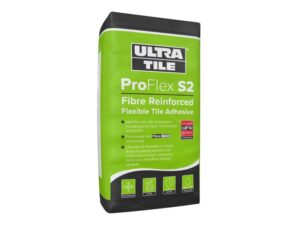
- UltraTile ProFlex S2 – A high-performance S2 tile adhesive with exceptional flexibility. Perfect for timber substrates, heated floors, and large format tiles.
- UltraTile ProPave Mortar – Designed for external tiling on patios and paving, this is a fibre-modified cement binder offering strength and durability in all weather.
Rapid Set Adhesives
 For fast-paced jobs, rapid set tile adhesive is the go-to. These adhesives cure in as little as 2–3 hours, allowing for quicker grouting and reduced downtime — ideal for commercial jobs or tight deadlines.
- UltraTile ProFlex S2 also falls into this category with rapid curing, making it ideal when speed and flexibility are both essential.
Ready-Mixed Adhesives (D-Class)
 Ready-mixed adhesives come pre-prepared and are best suited for small wall areas with ceramic tiles only. They are not recommended for porcelain or floor tiling due to their slower drying times and lower bond strength.
- UltraTile ProSuper Grip – A high grab acrylic wall tile adhesive, perfect for small ceramic tiles in dry or lightly damp wall areas.
Epoxy Adhesives (R-Class)
 Epoxy-based adhesives offer maximum chemical resistance and durability. These are often used in commercial kitchens, swimming pools, or heavy-duty applications.
- UltraTile ProGrout Epoxy – While technically a grout, this product offers epoxy-level performance where resistance to chemicals, staining, and abrasion is critical.
How to Choose the Best Tile Adhesive for Your Project
When it comes to tiling, one of the most important decisions you’ll make is choosing the right adhesive. The wrong choice could lead to cracking, lifting, or even complete tile failure over time. To help you make the right call, here are the key factors to consider — along with the UltraTile products we recommend for each scenario:
-
What Type of Tile Are You Using?
Ceramic Tiles (Wall Only):
For small-format ceramic wall tiles in kitchens or splashbacks, a ready-mixed adhesive like UltraTile ProSuper Grip is usually sufficient.
Porcelain, Natural Stone or Large Format Tiles:
These denser materials require a powdered, flexible tile adhesive. For standard jobs, choose UltraTile ProSS Flex. For installations requiring more give (e.g. timber substrates or large-format tiles), use UltraTile ProFlex S2, which meets S2 deformability standards for maximum flexibility.
-
Where Are the Tiles Being Installed?
Walls:
Use UltraTile ProSS Flex or ProSuper Grip, depending on tile size and surface.
Floors (Interior):
Always go for a cement-based powdered adhesive. We recommend UltraTile ProSS Flex for most interior floors, or ProFlex S2 where underfloor heating is present or the substrate has movement.
Wetrooms or Bathrooms:
Wet areas need extra performance. Choose adhesives with strong moisture resistance and flexibility. UltraTile ProFlex S2 is an excellent choice here, especially when paired with a tanking system like AquaTank.
Exterior or Patio Tiling:
Outdoor installations demand adhesives designed for extreme conditions. UltraTile ProPave Mortar and UltraTile ProPave Primer are made specifically for external tile and stone installations.
-
What Substrate Are You Tiling Onto?
| Substrate | Recommended UltraTile Adhesive |
| Plasterboard | ProSS Flex or ProSuper Grip (small format ceramic only) |
| Cement Board | ProSS Flex, ProFlex S2 |
| Timber Floors | ProFlex S2 (flexible S2 adhesive is essential for movement absorption) |
| Heated Floors | ProFlex S2 (handles expansion/contraction due to temperature) |
| Concrete or Screed | ProSS Flex, ProFlex S2 |
| Exterior Substrate | ProPave Mortar + Primer |
-
Do You Need Standard Set or Rapid Set?
- Use standard set tile adhesive like ProSS Flex when working with intricate layouts, large areas, or if extra adjustment time is needed.
- Choose rapid set adhesive (like ProFlex S2) for quick turnarounds — perfect for commercial work, bathroom refits, or time-sensitive jobs.
Understanding Tile Adhesive Classifications (C2, S1, S2 & More)
If you’ve ever looked at the label on a bag of tile adhesive and felt lost in a sea of letters and numbers, you’re not alone. Understanding adhesive classification is key to choosing the right tile adhesive for long-lasting, safe installations — especially in high-performance or specialist environments.
In the UK and across Europe, adhesives are classified under EN 12004 — a standard that outlines how tile adhesives should perform. Let’s break it down:
Key Tile Adhesive Classification Codes
| Code | Meaning |
| C | Cementitious adhesive (needs to be mixed with water) |
| D | Dispersion (ready-mixed adhesive) |
| R | Reaction resin (epoxy adhesive) |
| 1 / 2 | 1 = Standard performance, 2 = Improved performance |
| F | Fast-setting |
| T | Reduced slip |
| E | Extended open time |
| S1 | Deformable adhesive (can flex up to 2.5mm) |
| S2 | Highly deformable adhesive (can flex over 5mm) |
What Does “C2 S1” Mean on Tile Adhesive?
Let’s take UltraTile ProFlex S2 as an example. The classification might read C2FT S2, which tells you:
- C2: Cement-based with improved performance
- F: Fast-setting
- T: Reduced slip
- S2: Highly flexible (can handle significant movement)
This adhesive is ideal for demanding installations like underfloor heating, timber substrates, or large format tiles, where movement and vibration are likely.
S1 vs S2 Tile Adhesive: What’s the Difference?
| Feature | S1 Adhesive | S2 Adhesive |
| Flexibility | Medium (2.5mm deformation) | High (5mm+ deformation) |
| Ideal For | Most floors, walls, small movement areas | Timber, heated floors, balconies, etc. |
| Example UltraTile Product | ProSS Flex (S1) | ProFlex S2 |
Tip: If in doubt, choose S2 for maximum flexibility and performance — especially for commercial, external, or wetroom installations.
When Should You Use R-Type (Resin-Based) Adhesives?
UltraTile ProGrout Epoxy is a two-part reaction resin adhesive (R2). This type is often used in:
- Commercial kitchens
- Swimming pools
- Areas with chemical exposure
- Industrial projects where maximum bond strength is critical
Although harder to apply, resin adhesives offer exceptional water resistance, durability, and hygiene.
This classification system makes it easier to compare adhesives based on your tiling project needs — ensuring a professional result every time.
UltraTile Product Spotlight – Adhesives for Every Application
When it comes to choosing a professional-grade tile adhesive, UltraTile offers one of the most comprehensive and trusted ranges available in the UK and Ireland. At Quantum Group, we stock the full suite of UltraTile adhesives, ensuring you have the right solution for every substrate, tile type, and site condition — whether you’re working on kitchen splashbacks, hotel wetrooms, or heated screeds.
Below, we break down our most popular UltraTile products and their ideal use cases.
UltraTile ProSS Flex: Standard Set Flexible Tile Adhesive (C2TE S1)
- Type: Cementitious | Standard Set | Flexible (S1)
- Best for: Wall and floor tiles, large format porcelain, natural stone
- Benefits:
- Extended open time
- Reduced slip
- Suitable for underfloor heating
- Excellent grab and bond strength
If you’re looking for a reliable flexible adhesive for general wall or floor installations, ProSS Flex is a fantastic all-rounder. It’s especially suitable where working time is needed — such as laying metro tiles in detailed herringbone layouts or tiling large-format floors.
UltraTile ProFlex S2: Rapid Set, Fibre-Reinforced Flexible Tile Adhesive (C2FT S2)
- Type: Cementitious | Rapid Set | Highly Flexible (S2)
- Best for: Heated screeds, timber floors, movement-prone substrates
- Benefits:
- Deformability over 5mm (S2 rated)
- Rapid setting in 2.5–3 hours
- Fibre-reinforced for extra strength
- Perfect for underfloor heating systems, balconies, or conservatories
Installers love ProFlex S2 when time is tight but performance can’t be compromised. It’s your go-to choice for challenging substrates or tiling over suspended floors.
UltraTile ProRapid RS: Rapid Set Flexible Adhesive (C2FT)
- Type: Cementitious | Rapid Set | Flexible
- Best for: Fast-track flooring, showrooms, retail fit-outs
- Benefits:
- Sets in just 2 hours
- Suitable for porcelain, ceramics, and natural stone
- Works with underfloor heating
- Ideal for projects needing quick turnaround
Need a fast-setting adhesive that doesn’t compromise on bond strength? ProRapid RS is perfect for high-traffic areas or time-sensitive installations.
UltraTile ProSuper Grip: High Grab Acrylic Wall Tile Adhesive (D2TE)
- Type: Ready-mixed dispersion adhesive
- Best for: Small format ceramic wall tiles (up to 300x300mm)
- Benefits:
- High initial grab
- No need to mix
- Excellent for kitchen splashbacks and bathrooms
- Non-slip formula for easy vertical tiling
This is the ideal wall tile adhesive for ceramic tiles in dry or damp areas like bathrooms and kitchens. Easy to use, fast to apply.
Key Installation Tips for a Perfect Bond
Even the best tile adhesive can underperform if not applied correctly. Whether you’re working with UltraTile ProRapid RS, ProFlex S2, or ProSuper Grip, following professional installation techniques will ensure the tiles stay firmly in place for years — preventing tile movement, lippage, or water damage.
Here are our top tips for ensuring your tile adhesive performs at its best:
1️. Prepare the Substrate Properly
Ensure the surface is clean, dry, and free from dust, grease, or loose particles.
For plaster or plasterboard, always use a suitable primer to reduce absorbency.
For concrete or screed, ensure it’s fully cured — 6 weeks minimum for fresh screed.
Use UltraTile ProPrimer to enhance adhesion on absorbent or dusty substrates.
-
Choose the Right Notched Trowel
The trowel size must match the tile size and adhesive type:
- Small wall tiles: 6mm square-notched trowel
- Standard floor tiles: 10mm
- Large format tiles: 12–20mm or back-buttering required
The goal is 100% adhesive coverage beneath the tile — especially important for porcelain tiles, wetrooms, and exterior applications.
-
Mix Powdered Adhesives Correctly
Always follow the UltraTile instructions for mixing powdered adhesives.
Use a paddle mixer and mix for the recommended time (typically 3–5 minutes), then allow it to rest for 2 minutes (slake) before remixing. This activates the polymers and ensures consistent setting performance.
4️. Apply in Manageable Areas
Don’t spread more adhesive than you can tile within the open time (usually 20–30 minutes for standard set, 10–15 minutes for rapid set). If adhesive starts to skin over, remove and reapply. Always check the adhesive bed with your finger — it should transfer to the fingertip.
5️. Back-Butter Large Tiles
For tiles over 600x600mm or heavy porcelain tiles, apply adhesive to both the tile and substrate. This ensures full coverage and avoids voids that could cause cracks or sound hollow underfoot.
6️. Use a Tile Levelling System
For flawless alignment and to prevent lippage, use a system like the Tylix clips and wedges. This is especially helpful for large format tiles, ensuring a flat, professional finish.
7️. Watch the Temperature & Conditions
Avoid tiling in temperatures below 5°C or above 35°C. Don’t tile in direct sunlight or windy conditions — this can dry out the adhesive too quickly.
8️. Don’t Grout Too Soon
Follow the setting time recommendations for your chosen adhesive:
- Standard set: Wait 16–24 hours
- Rapid set: Ready to grout in as little as 2–3 hours
Premature grouting can weaken the bond and cause tiles to lift.
Order from Quantum Group | Trusted by Merchants & Showrooms throughout the UK and Ireland
We supply the full UltraTile range to retailers, showrooms and merchants across the UK & Ireland. With next-day delivery, technical support, and trade pricing, we’re here to help you deliver the highest standards in tiling.
💬 Need help choosing the right adhesive?
📞 Call us on: +44 (0)28 7131 2064
📧 Email: [email protected]